The way a clinician writes a note is personal. The order of the sections, the words chosen, how much history makes it in, what goes in the plan. It reflects years of training and a way of thinking.
But the note does not stay with the person who wrote it. It goes to the colleague on the night shift, the specialist receiving the referral, the nurse checking the plan, the team that bills the visit. The note is personal. The patient is shared.
Every good note has to do both jobs at once: sound like its author and read clearly to anyone who picks it up.
Other professions found the balance long ago
A lawyer drafts in her own voice. Two partners at the same firm will argue the same case in very different prose. Yet the contract follows a structure every lawyer recognizes: definitions, obligations, termination, governing law. Any colleague, any counterparty, any judge knows where to look.
An accountant builds working papers his own way, with his own shortcuts and his own checks. The financial statements that come out of them follow shared reporting standards, so an auditor, an investor or a new hire reads them without a phone call.
An architect has a signature. You can often tell whose building it is from across the street. The drawings behind it use the same symbols, scales and conventions as everyone else's, so any contractor can build it.
In each case the craft is personal and the output is portable. Style sits on top. The standard sits underneath. Nobody is asked to choose between the two.
Medicine has been forced to pick a side
Clinical documentation rarely gets that balance. Lean too far toward standard and the note becomes a checklist: every field filled, every box ticked, and the reasoning that made the visit matter lost between the lines. Lean too far toward bespoke and the colleague who opens it at 2 a.m. cannot find the plan.
Most documentation tools choose one side for the clinician. A fixed template that fits nobody well, or free text that only its author can navigate. Neither serves the patient, who needs both a clinician who documents the way they think and a team that can act on it.
Build it your way
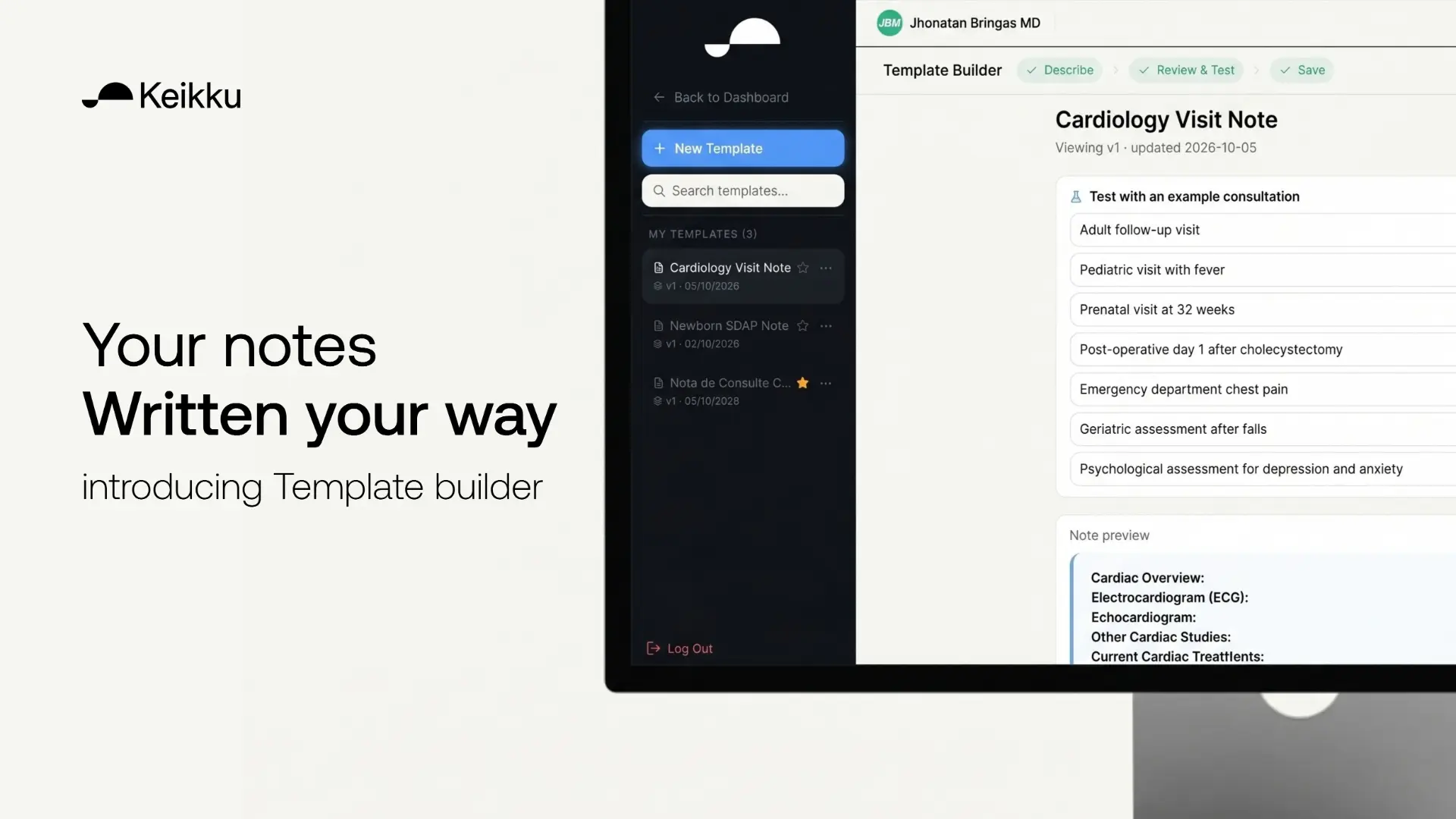
Today we are introducing Note Builder. It gives every clinician the bespoke layer: the structure, length and voice of the notes Scribe writes for them.
There are two ways to start. Upload a PDF of a note or template you already use, and Note Builder reads its sections, order and level of detail. Or describe what you want in your own words, in the language you practice in: "Open with the reason for visit, keep the history to three lines, close with a plan the patient can understand." Either way, you get a working template in minutes.
Build a four-line follow-up and a two-page consult letter. Keep SOAP and adjust one section, or design something new. Refine it after a clinic day and every change applies to your next note.
Hand it to anyone
What stays constant is what lies underneath. However a note is shaped, the same clinical intelligence sits behind it. Reference checks each statement against the conversation and clinical knowledge before the note is handed over. Coding Intelligence attaches ICD-10, CPT and HCC codes to every note, whether it runs four lines or four pages.
That shared layer is what makes a personal note portable. The colleague covering your patients reads the same verified facts and the same codes, written in your voice. The specialist receiving the referral does not need to learn your style to find what matters. The billing team works from the same standard on every note, from every clinician.
Like the contract, the ledger and the blueprint, the craft is yours and the language is shared.
Available today
Note Builder is live now in Keikku on Clinician Pro, Complete and Enterprise. Every new clinician starts with a 14-day Clinician Pro trial, no credit card required.
Start with a PDF or a sentence. Write it your way. Hand it to anyone.