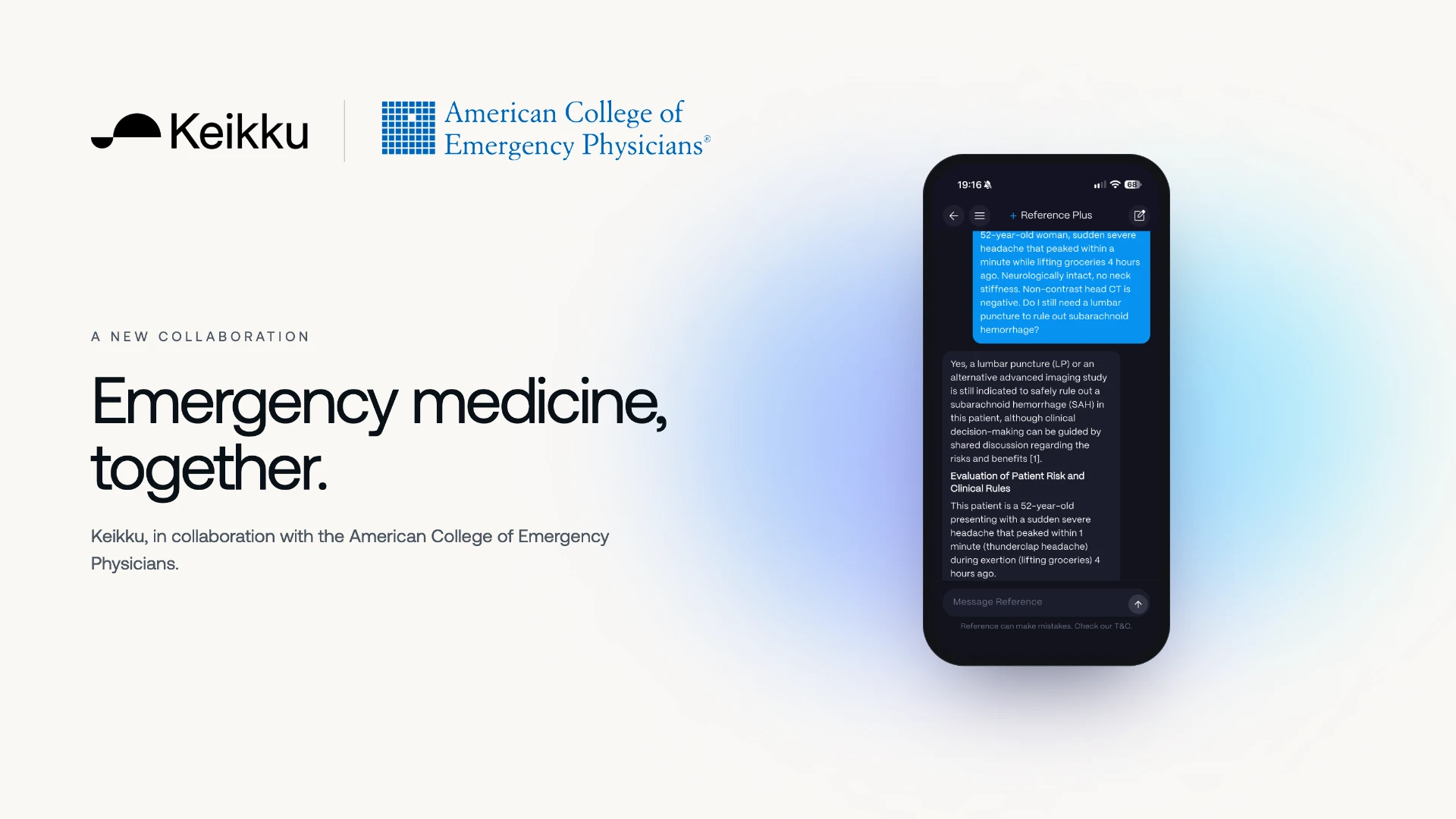
Today we're announcing a collaboration with the American College of Emergency Physicians (ACEP) to bring ACEP's clinical policies into Reference, the platform's cited clinical reference. The collaboration is clinical and educational, with no commercial terms attached.
ACEP's clinical policies are developed by the College's Clinical Policies Committee and approved by its Board of Directors, and address the evaluation and management of patients in the emergency setting. Within Reference, they sit alongside the platform's curated clinical sources, attributed to ACEP. ACEP remains the source and owner of its content.
Built for the practice of medicine, alongside academic search
Academic search tools are built to find the literature, and they remain essential. Reference adds the step that comes after: applying that evidence to the patient in the room. It builds clinical context throughout the encounter from four sources: the patient's record via Keikku's EHR integration, every prior session, the live consultation as Scribe | AI Notes captures it, and lab and imaging results as they arrive.
When an urgent care clinician asks whether a patient can be managed on site or needs transfer to an emergency department, the answer is grounded in ACEP guidance and shaped by the findings already documented. Every answer is cited, and every decision stays with the clinician.
Curiosity and humility, by design
Reference also runs on BODHI, a framework for curiosity and humility in clinical AI developed by researchers at MIT Critical Data and collaborators, published in BMJ Health and Care Informatics and PLOS Digital Health, and implemented by Lapsi Health's data science team.
Under BODHI, the model weighs how uncertain a case is, asks for the information it is missing, states the limits of its confidence, and defers to the clinician when the evidence runs out. In emergency medicine, knowing what it does not know matters as much as knowing the guideline.
What both organizations are saying
"We are proud to bring ACEP's guidance into Reference," said Jhonatan Bringas Dimitriades, MD, CEO and Co-Founder of Keikku. "Emergency and urgent care clinicians decide in minutes what shapes a patient's next days. They should not have to step away from the patient to find the answer. Reference brings the College's guidance into the consultation, already applied to the patient in front of them, and it is free for every clinician."
"Emergency medicine is complex, fast-paced, and often unpredictable. Integrating ACEP's evidence-based policies and clinical guidance into decision support tools puts trusted resources at physicians' fingertips when seconds matter," said ACEP President Ryan Stanton, MD, FACEP.
ACEP's participation does not constitute an endorsement of Keikku or of any Lapsi Health product. ACEP clinical policies are not intended to represent a legal standard of care, and Reference supports, but does not replace, the clinician's judgment.