Remote care solved the problem of distance. It did not solve the problem of the clinician working alone.
In a clinic, a physician is surrounded by quiet support. A nurse has already taken the history. A colleague is down the hall for a second opinion. The chart sits on the desk. In a video consult, most of that disappears. The clinician is one person, one screen, and one patient who may be hundreds of kilometers away.
That is why AI tools matter more in remote work than anywhere else in medicine. Not as a novelty, but as the support structure that the consulting room used to provide.
The note follows you home
Documentation was already the heaviest part of the job before telemedicine went mainstream. A 2016 time and motion study in the Annals of Internal Medicine followed 57 physicians across four specialties. For every hour of direct patient care, they spent nearly two more hours on the EHR and desk work, plus one to two hours each night at home (Sinsky et al.).
Remote care made this worse, not better. A 2023 study in JAMA Internal Medicine tracked 1,052 physicians over 115 weeks. The more of their schedule they moved to video, the more time they spent in the EHR, both during and after clinic hours (Holmgren et al.).
A separate primary care study in JAMA Network Open found that hybrid days, mixing video and in-person visits, added roughly 15 minutes of active EHR time per day. The authors pointed to multitasking: on video, clinicians type into the record while the patient is still talking (MedStar Health).
That last finding is the real problem. In a video consult, the screen is both the patient and the chart. Every second spent typing is a second of eye contact lost.
Less signal, more to remember
A video consult gives the clinician less to work with. A systematic review of telemedicine during the pandemic found the same limits again and again: a reduced physical exam, nonverbal cues that are hard to read, and tests that cannot be done remotely (BMC Medical Informatics and Decision Making).
Patients feel the gap too. In one qualitative study of older adults, participants worried that seeing a clinician less often in person weakened continuity and care coordination (JMIR Aging).
When the exam gives less, the history has to give more. That means the clinician needs the whole patient in front of them: prior visits, recent labs, current medications, what was said last time. On video, that context usually lives in another tab, another system, or nowhere at all.
The question nobody answers
Clinicians raise clinical questions constantly. A systematic review in JAMA Internal Medicine found about one question for every two patients seen. Roughly half were never pursued, and lack of time was a leading reason. When clinicians did look, they found an answer most of the time (Del Fiol et al.).
The answers exist. What is missing is a way to reach them without breaking the consult. In a clinic, the quick route is often a colleague in the next room. Working remotely, there is no next room. Searching a database mid call means looking away from the patient and leaving the conversation.
So the question waits until after the visit, or it never gets asked at all. In remote care, the cost of a lookup is higher, and the safety net is thinner.
Three jobs for AI in the remote consult
The right AI tool does not add another screen. It takes work off the one screen the clinician already has. In a remote consult, that work falls into three jobs.
It writes. Ambient documentation listens to the visit and drafts the note, so the clinician can look at the patient instead of the keyboard. The early evidence is encouraging. A 2025 multicenter study in JAMA Network Open followed 263 clinicians across six US health systems. After 30 days with an ambient scribe, burnout fell from 51.9% to 38.8%, after hours documentation dropped, and clinicians reported more undivided attention for patients (Olson et al.).
It answers. A clinical question raised on a call should get a cited answer on the same call, without leaving it. The answer should come from trusted guidelines and literature, and it should show its sources so the clinician can judge them.
It remembers. The tool should carry the patient: prior visits, the record, labs, and what is being said right now. That is what replaces the paper chart on the desk and the nurse who took the history. It is also what turns a generic answer into one that fits this patient.
Each job helps on its own. The real gain comes when they share one context. The note informs the answer, the answer is grounded in the patient's history, and nothing has to be typed twice.
What to demand before you trust it
AI in a remote consult sits between the clinician and the patient. That position deserves scrutiny. Before adopting any tool, clinicians should be able to answer yes to five questions.
-
Does it cite its sources? Every clinical answer should trace back to a guideline or paper you can open and judge.
-
Does it state its uncertainty? A tool that sounds equally sure about everything is a risk. It should say where the evidence is thin.
-
Does the clinician stay in charge? Notes and codes are drafts. Nothing should reach the record without review and confirmation.
-
Is the data protected? Video, audio, and notes are health data. Ask where they are stored, who can access them, and which regulations the vendor meets.
-
Does it work for your patients? Remote care often crosses languages and regions. The tool should handle the languages your patients speak and the guidelines your practice follows.
These are not extras. In a consult where the clinician cannot touch the patient or turn to a colleague, they are the minimum.
Building the consulting room back
Telemedicine gave patients access. The next step is giving clinicians back the support they lost when they left the building.
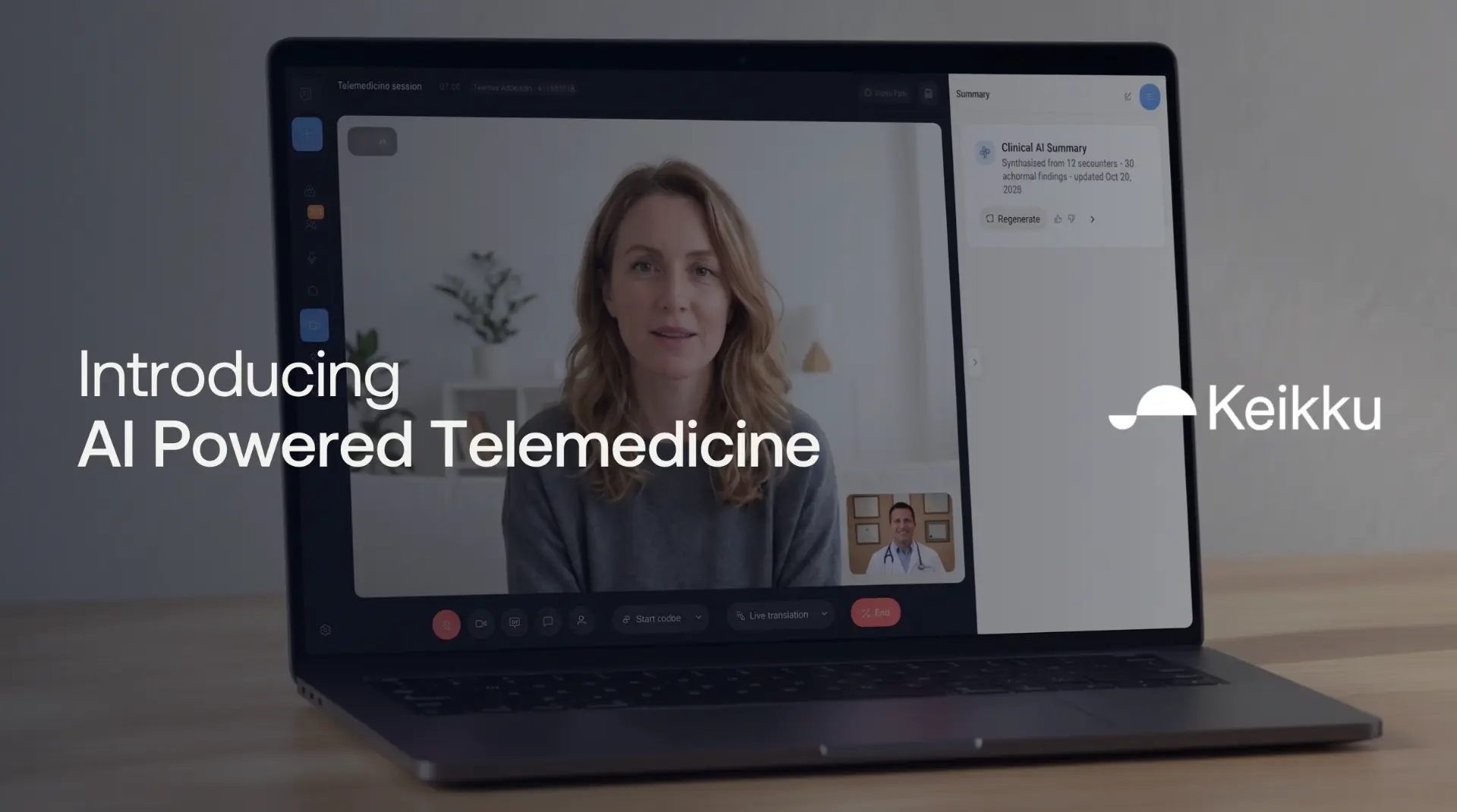
This is why Keikku is launching AI-powered telemedicine today, worldwide. It brings Scribe, Reference, and Clinical Summaries together in a single video consultation. The clinician arrives already knowing the patient, documents nothing by hand, and gets cited answers without looking away. The patient gets a doctor who is fully present. One session, one context, and a clinical mind working beside both of them.
Distance is no longer the hard part of remote care. Working alone is. AI should make sure no clinician has to.
References
-
Sinsky C, Colligan L, Li L, et al. Allocation of physician time in ambulatory practice: a time and motion study in 4 specialties. Ann Intern Med. 2016;165:753-760. Summary
-
Holmgren AJ, et al. Telemedicine use and physician EHR time. JAMA Intern Med. 2023. Summary
-
MedStar Health. Telehealth, hybrid care and primary care EHR time. JAMA Netw Open. Summary
-
Challenges of telemedicine during the COVID-19 pandemic: a systematic review. BMC Med Inform Decis Mak. 2022. Table
-
Perceived limitations of virtual care for older adults. JMIR Aging. 2022;5(4):e38546. Table
-
Del Fiol G, Workman TE, Gorman PN. Clinical questions raised by clinicians at the point of care: a systematic review. JAMA Intern Med. 2014;174(5):710-718. Abstract
-
Olson KD, et al. Use of ambient AI scribes to reduce administrative burden and professional burnout. JAMA Netw Open. 2025;8(10):e2534976. Summary