Last week, at a conference of the National Health IT Collaborative for the Underserved in Washington, I heard a clinician tell a story from her childhood.
This clinician is the child of brave and hardworking immigrants from Latin America. As a girl, she witnessed firsthand the uncertainty and danger of the language barrier, and she took it upon herself to become the intermediary for her non-English-speaking parent, standing beside her father at the hospital and carrying words between him and the doctor that no child should have to carry, diagnoses, instructions, fears, in a language he did not speak.
It was an act of heroism, and an early sign of the vocation of service that would define her. But it was also deeply unfair, the kind of unfairness that falls on immigrants everywhere. I know it because I am one. I arrived in the Netherlands without a word of Dutch.
That childhood experience left a profound mark on her, and the mark seeded something transformational. She grew up to become a clinician herself, and she chose community health, the work of caring for the people whose voices the system struggles to hear. What could have remained a painful memory became the reason she does what she does.
Her story stayed with me, because it names something we do not talk about enough. For millions of people, the hardest part of seeing a doctor is not the illness. It is not being understood.
We carry our identity in the language we speak
We carry our identity in the language we think in. It is how we describe pain, how we tell the story of what is wrong, how we understand what we are asked to do. And this is not about translation. It is about letting the millions of encounters where a clinician and patient already share a language happen in that language, instead of forcing them into English.
It matters clinically, not just emotionally: around 25 million people in the United States are limited English proficient, and in one systematic review, 76% of studies (25 of 33) demonstrated that at least one outcome was better for patients receiving language-concordant care, better comprehension, better adherence, better control of chronic disease. Care in a shared language even outperforms care through an interpreter, because nuance is the raw material of diagnosis, and nuance is what gets lost in the handoff.
Why we are launching multilingual support
Our mission is not only to deliver incredible multilingual care in the United States and Europe, but also to reach the places where clinical innovation has lagged, often the same places our immigrant patients come from. The languages we support at home are the languages spoken there, so serving one serves the other. We support them too, and we want to arrive the right way: as a trustworthy, certified AI partner, carrying the same regulatory proof we hold in the most demanding markets in the world. Meeting people in their own language, and doing it with validated technology, is how this reaches the clinicians and patients who have waited longest for it.
This is why Keikku now speaks more than one language, and why it will keep learning more.
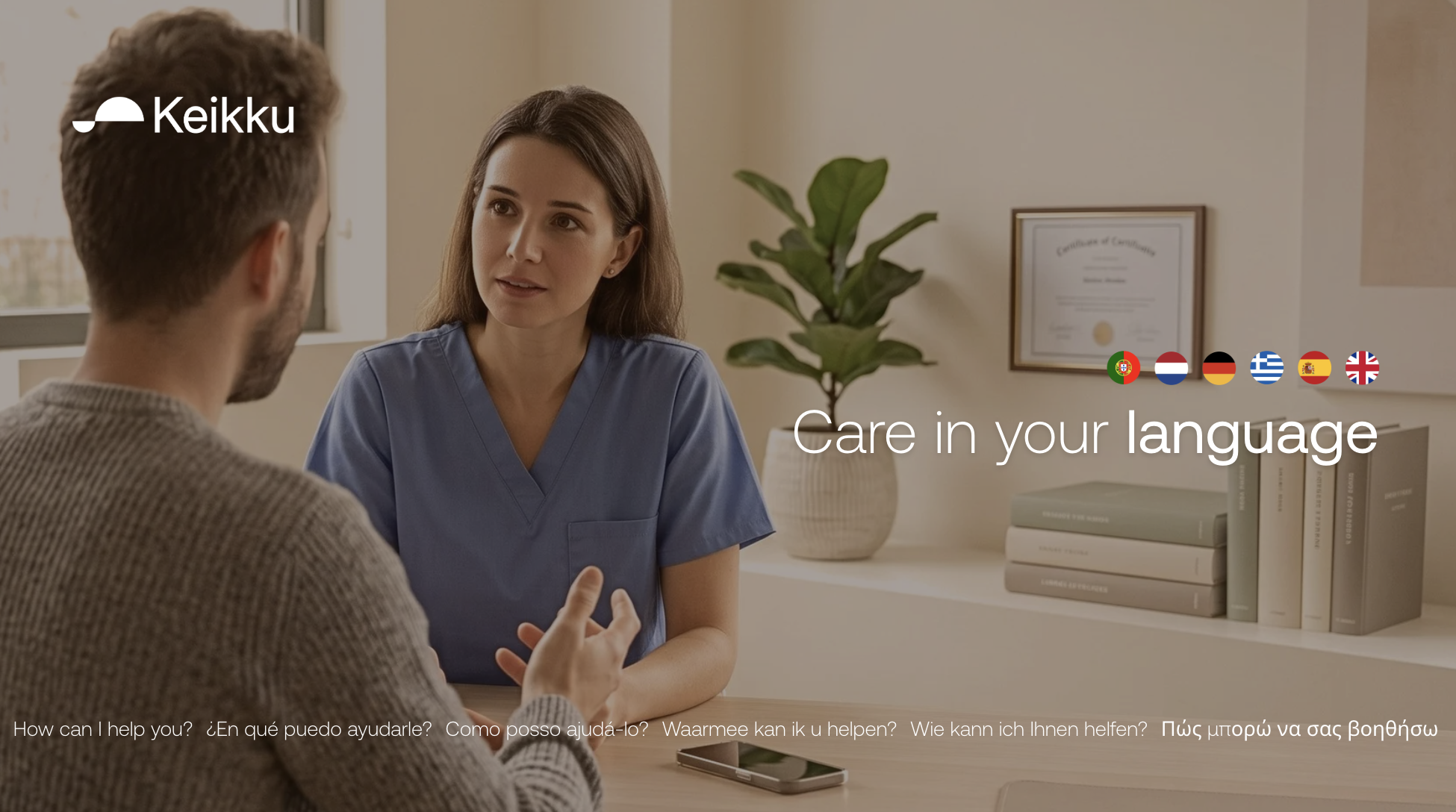
In the past week we launched support for Spanish, Portuguese, German, Dutch, and Greek, and we are adding new languages continuously, with many more to come in the weeks ahead. Our aim is to keep pace with the movement of people and the communities most in need, until a clinician and a patient can meet in their own language almost anywhere.
Here is what that makes possible. A Mexican clinician can speak with a Mexican patient in Spanish, the way both of them are most comfortable, most precise, most themselves, and Keikku documents the encounter automatically in English. No one has to choose between being understood and being on the record. The conversation happens in the language of the patient. The paperwork happens in the language of the system. The clinician is freed to simply care.
What this is really about
This is more than a feature. It is a small act of returning something that medicine quietly took away: the right to be sick, and to be cared for, in your own words.
Our goal is that communities, immigrant or not, will receive healthcare they understand and trust, because the clinician in the room, and the technology supporting them, will already speak their language.