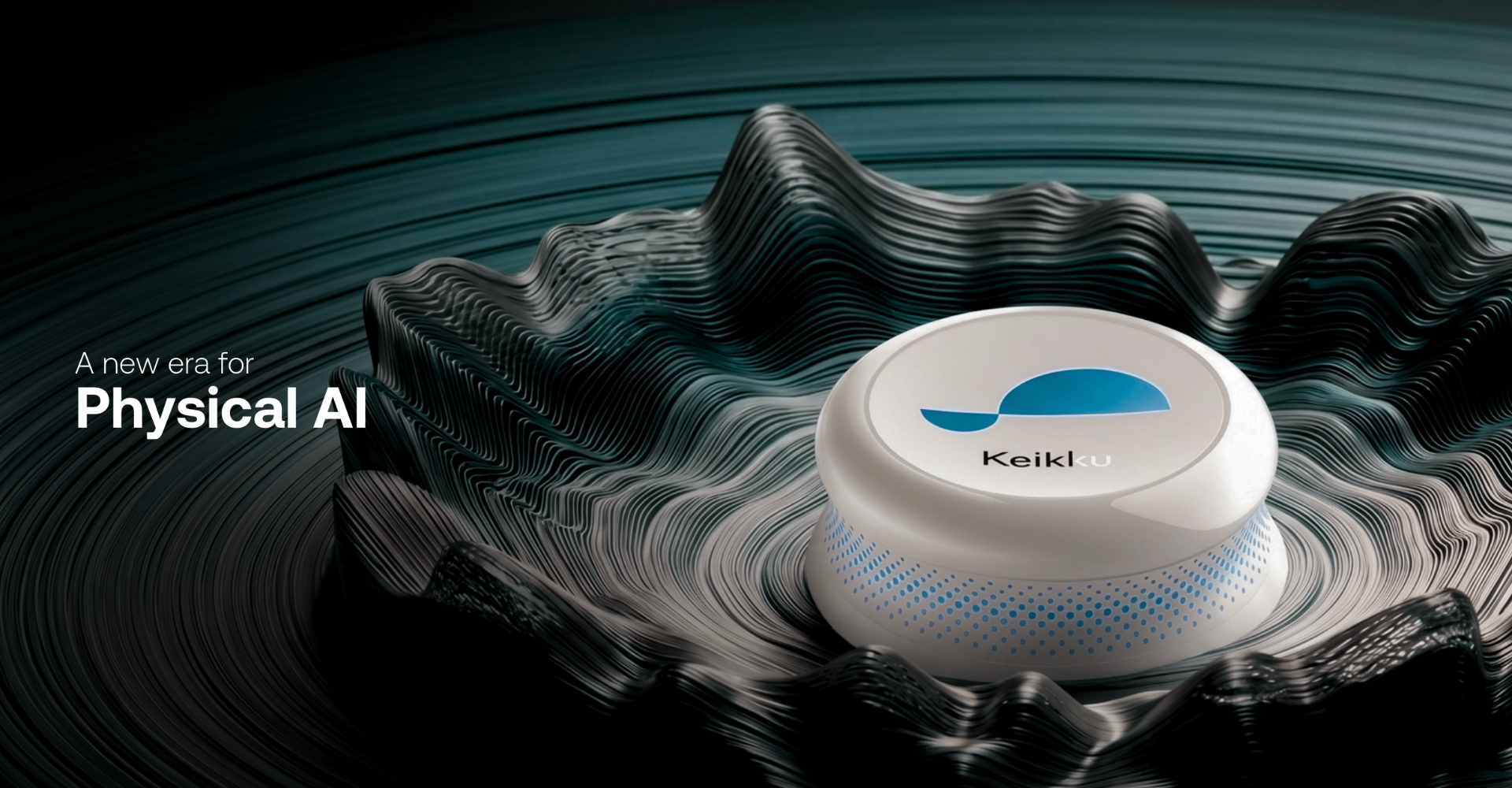
Something is happening in hardware that has not happened since the smartphone. A new category of device has appeared, built from the ground up around Artificial Intelligence (AI) rather than bolting AI onto an existing product. These devices share a family resemblance. They listen, they see, or they sense. They live in the physical world rather than behind a screen. And their real product is not the hardware at all, but the intelligence the hardware makes possible. This is Physical AI, and the biggest names in technology are now racing into it.
By Jhonatan Bringas Dimitriades, MD | Augmented by Keikku AI
The clearest signal of how serious this shift is came when OpenAI, the maker of ChatGPT, paid roughly 6.5 billion dollars to acquire io, the hardware startup founded by legendary Apple designer Jony Ive. The device they are building is reported to be pocket-sized, screenless, and contextually aware, gathering information from its surroundings through built-in cameras and microphones, with AI as the entire point. When the company that defined modern AI and the designer who defined the modern smartphone join forces on an ambient, screenless, AI-native device, the direction of travel is no longer in doubt. Physical AI is the next platform.
So the consumer world has its answer to Physical AI. Medicine does not, at least not yet. The interesting question is why, and what a Physical AI device for healthcare would actually have to be.
The Physical AI family, and the lessons it has already taught
The first wave of Physical AI devices has already taught the category its most important lessons, and they come from both the successes and the stumbles.
The Meta Ray-Ban glasses showed that focus wins, putting a camera, microphones, and an AI assistant into ordinary-looking frames and passing two million units by doing hands-free capture well. OpenAI and Jony Ive's io represents the most heavily funded bet of all, a multi-billion-dollar wager that an ambient, AI-native device is the next great computing platform. And Plaud made the same point from the most focused angle of all: its credit-card-sized recorder captures conversations and uses AI to transcribe and summarize them, and that single, sharply defined job has carried it past a million units to become the world's top-selling AI note-taking device. The lesson from the winners is consistent: a Physical AI device succeeds when it is organized around a real, valuable job rather than a vague promise.
Humane taught a subtler lesson. Its AI Pin was a marvel of innovation, a screenless, voice-and-gesture wearable that was widely admired for its ambition and its design. The problem was timing. Both the technology and the audience were not yet ready: generative AI was less capable than it is today, and the world had not yet learned to live alongside ambient AI. The Pin sold a fraction of its target, and the company sold its assets to HP.
HP did not discard what it bought. It acquired Humane's AI platform, its engineers, and more than three hundred patents, and folded the technology into HP IQ, an ambient intelligence layer now rolling out across its devices in 2026. The hardware was too early, but the underlying bet on ambient AI was sound enough that a major company revived it. Two years on, with far deeper knowledge of generative AI than existed when the Pin shipped, the technology is finding its footing inside a consolidated platform. That is the real lesson: the Physical AI idea was never the problem. The form it took was.
Put the lessons together and a deeper pattern appears. Each winning device is defined not by its AI alone, but by the application it chooses and therefore the signals it captures. The Meta glasses capture image and sound, so they live in the world of seeing and hearing on the go. Plaud captures ambient voice, so it owns the conversation. OpenAI and io are building toward capturing ambience and image together. In every case the capability that matters as much as the AI is what the device can sense.
What Physical AI actually is, and what it is not
Physical AI means devices that capture real-world context and apply generative AI to it to perform multiple functions. Not Bluetooth-connected sensors with no compute power.
By that standard, the consumer devices sit on a spectrum. The most rigorous are clearly Physical AI: the capture is deliberate, high-quality, and central to the product. Others sit closer to the border. Plaud, for instance, is excellent, but it lives at the edge between true Physical AI and a well-made connected acquisition device, because much of its value is in capturing audio and sending it elsewhere to be processed.
A wave of legacy medical scribe companies, recognizing that audio quality shapes their performance, have begun pairing their software with connected hardware. But because these companies are built as software-first businesses, the hardware becomes a downstream accessory, a generic, off-the-shelf microphone with little to no onboard computing power. These are connected capture tools, not Physical AI platforms. This distinction is not just academic. It represents a fundamental divergence in how the reality of a clinical room is captured.
So what should a healthcare Physical AI device be?
With that definition in hand, the question almost answers itself. If you were to design a Physical AI device for medicine, what would it capture? Two things, the same two a good clinician has always relied on. The voice of the encounter, everything said in the room between a patient and the person trying to help them. And the physiology of the human body, the signals at the very center of any clinical assessment, captured in a way that is non-invasive, fast, and powerful.
Capture is necessary, but it is not sufficient. The component that turns a well-built sensor into a true Physical AI device is an AI thinking engine living at the heart of it, an intelligence that binds the captured data together and turns raw acoustic and physiologic signal into clinical meaning. Crucially, it does this not for one narrow task but across multiple applications, drawing on the same captured context to document, to interpret, and to inform. The advantage of owning both the sensing and the inference is that the device is not locked to the functions it launched with. The same captured signal can power new applications over time, deployed by the company as the AI advances, each one reaching the clinician through hardware they already have.
This is the structural advantage that a phone or a computer can never offer. When your product runs on someone else's device, you are limited to what their sensors capture and what their platform allows. When you own the sensing and the inference, every new model and every new capability becomes a new function you can ship onto a device already in the clinician's hands. That is what makes a genuine Physical AI device a platform rather than a clever accessory.
Why medicine, and why Keikku
The consumer Physical AI devices are racing to find problems worth solving. Medicine has the opposite situation: an overwhelming, urgent problem desperately in need of exactly this kind of device. Clinicians are drowning in administrative load and losing roughly a third of the day to documentation, while the signals that matter most, the physiology of the human body (heart, lungs, GI, and more), cannot be captured by a screen-bound app at all. Here the cost of poor capture is not a garbled meeting summary but a missed diagnosis.
This is where Keikku separates from the rest of the family. Its cousins each do one thing: a recorder captures speech, glasses answer a question. Keikku captures the encounter once and runs that signal through three connected AI engines that share one patient context. The AI Scribe uses Voice AI to turn the encounter into structured documentation with coding. Diagnostics AI, including AI Auscultation, extracts clinical meaning from the physical exam itself, the signal no software-only product can reach. And Reference brings context-aware answers to the point of decision, rooted in evidence. It scales as software alone across an entire organization at the speed of a login, and expands to software-plus-hardware where the exam demands the FDA-cleared device and its medical-grade sensing.
That clearance is the line no consumer device has to meet. Keikku is built for diagnostic fidelity and cleared to support clinical decisions, which is the difference between the meeting room and the consulting room.
One illustration: Keikku next to a focused consumer device
To make the difference concrete, it helps to set Keikku beside a single, well-executed consumer device. Plaud is the fairest comparison, because it does its one job exceptionally well. The contrast is not that Plaud is weak. It is that Keikku is a different kind of thing entirely.
| Plaud | Keikku | |
|---|---|---|
| Category | Consumer AI voice recorder | All-in-one Physical AI platform for healthcare |
| Primary user | Professionals, students, general consumers | Clinicians and health systems |
| Core capture | Ambient voice from meetings and calls | Clinical encounter audio plus heart and lung sounds |
| AI output | Transcription, summaries, notes | Structured clinical notes with ICD-10 and CPT coding |
| Diagnostics | None | Diagnostics AI with AI Auscultation |
| Clinical evidence | None | Context-aware referenced answers with Reference and CDS |
| Regulatory status | Consumer electronics | FDA-cleared medical device |
| Capture standard | Consumer-grade | Clinical-grade, built for diagnostic fidelity |
| Software-only option | Tied to the device | Full software-only tier, expands to software plus hardware |
| Shared patient context | Not applicable | One context shared across all three AI engines |
Same Physical AI roots. A focused consumer tool on one side, an all-in-one clinical platform on the other.
Systemic change in healthcare happens in stages, and Keikku is built for that reality. The platform deploys instantly as software alone on existing phones and computers, a friction-free way to onboard an entire organization, then serves as the stepping stone to the full Physical AI ecosystem, where the hardware, included with the subscription, adds medical-grade sensing and AI Auscultation.
Sources
- NPR. "OpenAI buys io, former Apple designer Jony Ive's device startup." 2025. npr.org
- TechCrunch. "Jony Ive to lead OpenAI's design work following $6.5B acquisition of his company." 2025. techcrunch.com
- Built In. "OpenAI's New Device: What We Know So Far." 2026. builtin.com
- Momentum Works (The Low Down). "How Plaud AI built the most successful AI voice recorder." 2025. thelowdown.momentum.asia
- Next Reality. "Meta Ray-Ban Smart Glasses Hit 2M Sales Milestone." 2026. virtual.reality.news
- HP Inc. "HP Accelerates AI Software Investments to Transform the Future of Work." 2025. investor.hp.com
- TechRadar. "HP repackages Humane AI acquisition into HP IQ AI platform." 2026. techradar.com
- TechCrunch. "Humane's AI Pin is dead, as HP buys startup's assets for $116M." 2025. techcrunch.com