Clinical AI in Latin America has moved past transcription. The question for a clinician in Lima, Bogotá, São Paulo or Mexico City is no longer whether software can write the note. It is what the software knows while the note is being written. This is a comparison of four providers active in the region. Each is built around a different answer to that question.
The providers
Keikku (Lapsi Health)
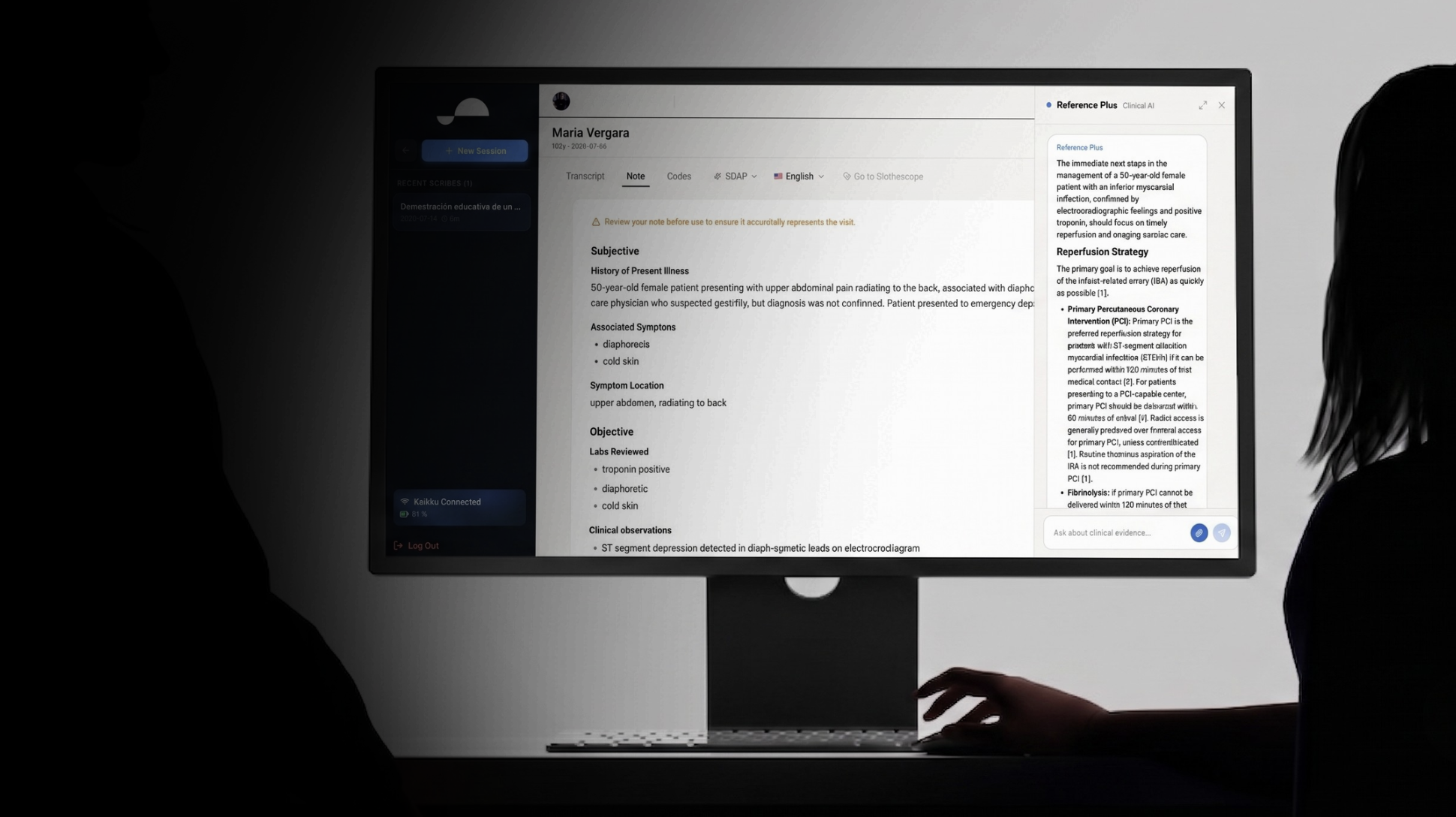
A clinical AI platform sold as software, running Scribe, Reference and Coding Intelligence, with a fourth pillar, Telemedicina, for Latin America. It is the entry in this comparison built to cover the consultation end to end. Scribe listens to the encounter and produces a structured note in the clinician's own writing style, learned from prior charts through Note Builder rather than from templates. It works in 13 or more languages, including Spanish and Portuguese, and the recording language and the note language can differ: a consultation in Spanish can be charted in English in the same session. Reference answers clinical questions with citations from PubMed, WHO and NIH and is free, unlimited and ad-free on every plan. Reference Plus, on paid plans, adds NICE, CDC, FDA and regional guidelines and reads the encounter Scribe is documenting, so a question asked mid-consultation is answered with that patient's medications and findings in view. Coding Intelligence adds SNOMED CT, ICD-10 (CIE-10), CPT and HCC codes to each note from the encounter itself. Telemedicina is a video consultation room inside the app where Scribe documents the call and Reference is available in the same window. Keikku Scribe is a CE MDR Class I medical device; Lapsi Health operates under ISO 13485 and ISO 27001, with HIPAA and GDPR compliance. It runs on iOS, Android and the desktop web app, exports to any EHR on every plan, and integrates natively on Enterprise. The app records offline and generates the note when connectivity returns, but generation itself is cloud based; its clinical sources are curated rather than exhaustive; and native EHR integration is not a standard-plan feature. New clinicians start on a free plan with no credit card and a 14-day Clinician Pro trial.
Arkangel AI (MedSearch)
A clinical search and audit engine built in Latin America. MedSearch returns cited answers to clinical questions, with a retrieval architecture tuned to avoid hallucination and a bibliography behind every response, and it is calibrated to regional public health protocols. It also carries a coding layer, a retrospective audit that scans existing records to flag missing ICD-10 and CPT codes, which makes it a revenue-protection tool for institutions as well as a reference engine. That audit is its clearest edge here: it works on charts that already exist, which no other provider in this comparison does. It does not record, transcribe or write notes, its coding runs after the fact rather than on the encounter, and it works from the question typed into it rather than from the consultation.
Telepatía AI
An enterprise ambient scribe for hospital networks in Spanish and Portuguese, built around connectors for the custom and legacy EHR systems common in Colombian and Brazilian hospitals. It also flags medication and protocol issues inside the note as it is written. For a hospital whose first question is whether the software plugs into its existing system, Telepatía has done that work. It does not carry a medical device certification, does not include a clinical reference engine, offers basic term mapping rather than full coding, and has no telemedicine.
Notavik
A notes app that runs entirely on the iPhone or iPad. Audio and transcripts never leave the device, which makes it the right choice for a practitioner whose regulatory environment, or personal threshold, rules out cloud processing of patient audio. The trade-offs follow from that design: no Android or web app, export by clipboard or share sheet, no coding, no clinical reference, and transcription running on the phone's own processor.
Marketplace and scheduling suites are left out of this comparison. They solve the front desk, not the consultation.
The comparison
| Keikku (Lapsi Health) | Arkangel AI (MedSearch) | Telepatía AI | Notavik | |
|---|---|---|---|---|
| Best for | Documentation, evidence and coding in one workflow | Deep literature search and chart audit | Hospitals on legacy EHRs | Fully offline documentation |
| Deployment in LATAM | Software only. Native apps and web | Software only. Browser and enterprise API | Software only. Web app and browser extension | Software only. iOS and iPadOS app |
| Ambient Scribe | Yes. Cloud based | No | Yes. Cloud based | Yes. On device |
| Clinical Reference | Yes. Reference: free, unlimited, cited, ad-free (PubMed, WHO, NIH). Reference Plus adds NICE, CDC, FDA and regional guidelines | Yes. Core product: cited answers, hallucination-resistant retrieval, regional protocols | No | No |
| Knows the patient | Yes. Reference Plus reads the live encounter | No. Retrospective screening of historical records only | Partial. Safety alerts inside the note | No |
| Coding on the encounter | Yes. SNOMED CT, ICD-10 (CIE-10), CPT and HCC on each note | No. Coding runs after the fact | Partial. Basic term mapping | No |
| Telemedicine | Yes. Built in. Scribe and Reference in the video consult | No | No | No |
| EHR connectivity | Yes. Export to any EHR on every plan. Native integration on Enterprise | Yes. Custom enterprise integrations | Yes. Custom connectors for local EHRs | Partial. Copy and paste, iOS share sheet |
| Legacy and custom hospital EHRs | Partial. Export on all plans. Custom integration on Enterprise | No | Yes. Hand-built connectors for Colombian and Brazilian systems | No |
| Offline operation | Partial. Records offline in the app. Note generates when back online | No | No | Yes. Fully on device. Audio never leaves the phone |
| Medical device certification | Yes. CE MDR Class I (Scribe) | Not published | Not published | Not published |
| Quality and security standards | Yes. ISO 13485, ISO 27001, HIPAA, GDPR | Yes. ISO 27001 | Not published | Not published |
| Spanish and Portuguese | Yes. 13 or more languages, including both | Partial. English and Spanish focus | Yes. Both, calibrated for regional variation | Partial. Spanish only |
| Cross-language notes | Yes. Record in Spanish, chart in English | No | No | No |
| Notes and templates | All note templates. Note Builder learns the clinician's charting style | Fixed audit templates | Configurable formats | SOAP variants |
| Native mobile app | Yes. iOS and Android, plus desktop web | No. Web only | No. Web and Chrome extension | Partial. iOS and iPadOS only |
| Free to start | Yes. Free plan, no credit card. 14-day Clinician Pro trial | Not published | Enterprise contract | Paid app |
Competitor entries reflect publicly documented product information. "Not published" indicates no public certification or pricing found.
Reading the matrix
Two rows go to the alternatives. Telepatía has done the work of connecting to legacy hospital systems. Notavik is the option where audio never leaves the phone. For a clinician whose decision turns on one of those, the choice is clear and it is not Keikku.
The rest of the table is about scope. Keikku is the entry that covers documentation, clinical evidence, coding and telemedicine together. Arkangel covers evidence and after-the-fact coding, Telepatía and Notavik cover documentation, and each leaves the clinician to assemble the rest from tools that do not share a patient record. Whether that matters depends on how much of the clinical day a clinician wants one system to handle.
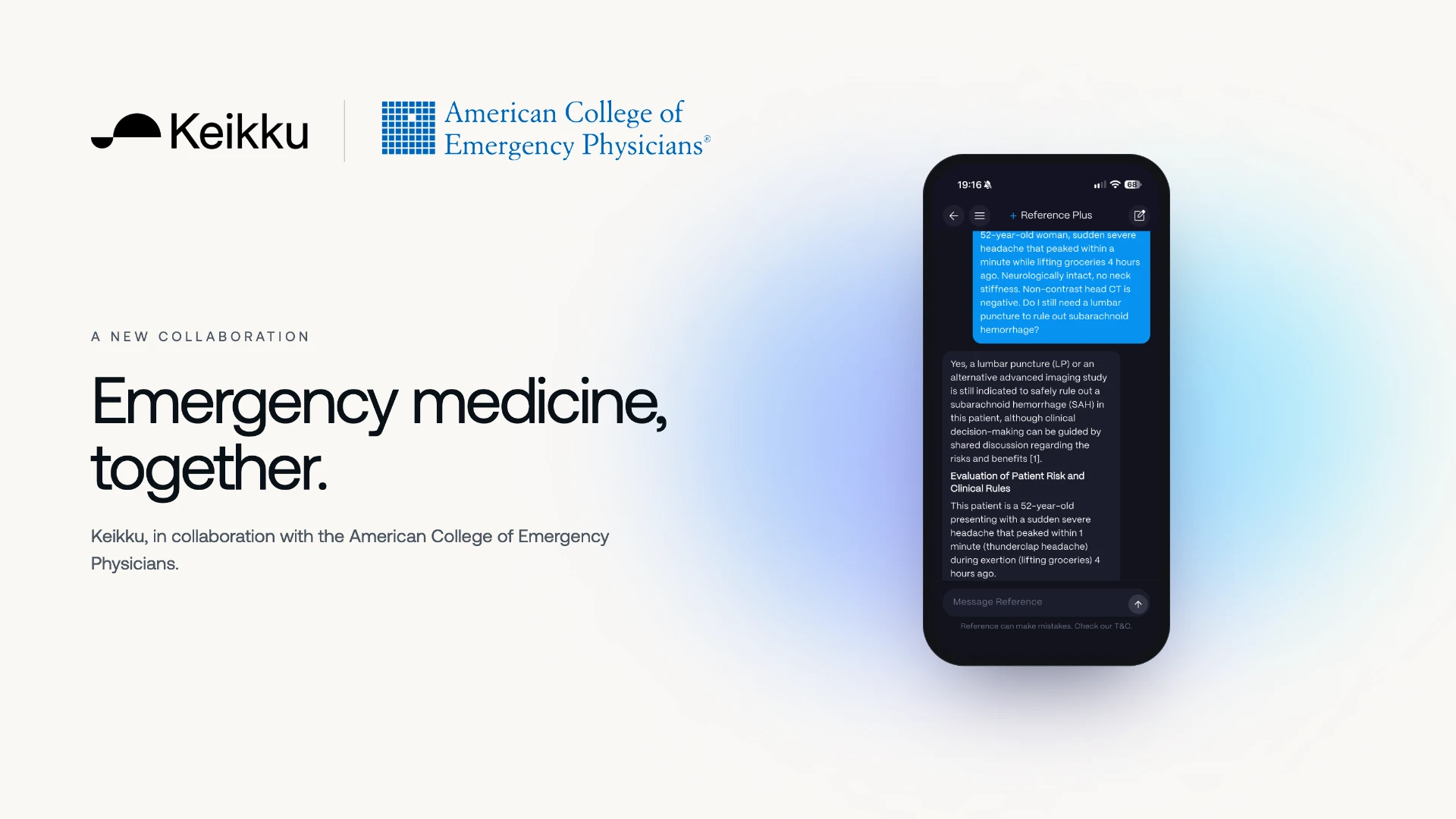
Context is the practical difference. A search engine answers the question it is given. A scribe writes down what it hears. Reference Plus does its search with the note Scribe is writing in view, so the answer accounts for the patient's medications and findings without the clinician re-typing them. None of the other three run both a scribe and a reference engine, so the question does not arise for them.
Reference costs nothing to start. Cited, ad-free, unlimited clinical answers are on Keikku's free plan. Arkangel also cites its answers; Keikku's are drawn from a curated set of trusted sources and, on paid plans, are patient-aware.
Certification matters to institutions. Keikku Scribe is a CE MDR Class I medical device and Lapsi Health operates under ISO 13485 and ISO 27001. Hospital procurement often requires this. The other three do not publish a medical device certification.
Android is a practical constraint. Most clinicians in the region carry an Android phone. Keikku and Telepatía reach them, through a native app and a browser respectively. Notavik does not run on Android, and Arkangel has no native app.
The new era
The first era of clinical AI in Latin America was about removing typing. The second is about what the software knows while the clinician works: the patient in front of them, the evidence behind the decision, and the code that has to leave the room with the note. Each provider in this comparison answers part of that. Keikku is built on the premise that the parts belong together.
Keikku runs on a phone or a browser today. The platform expands through the FDA-cleared Keikku Device in markets where it is distributed. In Latin America, the software is the product.