The AI Scribe is the most adopted form of clinical Artificial Intelligence (AI) in the world right now, used by roughly 30% of physician practices, and for good reason. It gives clinicians back time, reduces after-hours documentation, and lets the doctor look at the patient instead of the keyboard. But a peer-reviewed commentary in npj Digital Medicine in 2025 issued a clear warning: adoption is outpacing validation and oversight, and the rush to deploy these tools carries real risks to patient safety and clinical integrity. Understanding exactly how scribes fail is the first step to building one that does not. That is the work Keikku has done.
By Diana van Stijn, MD PhD | Augmented by Keikku AI
A scribe is a pipeline, and errors enter at every stage
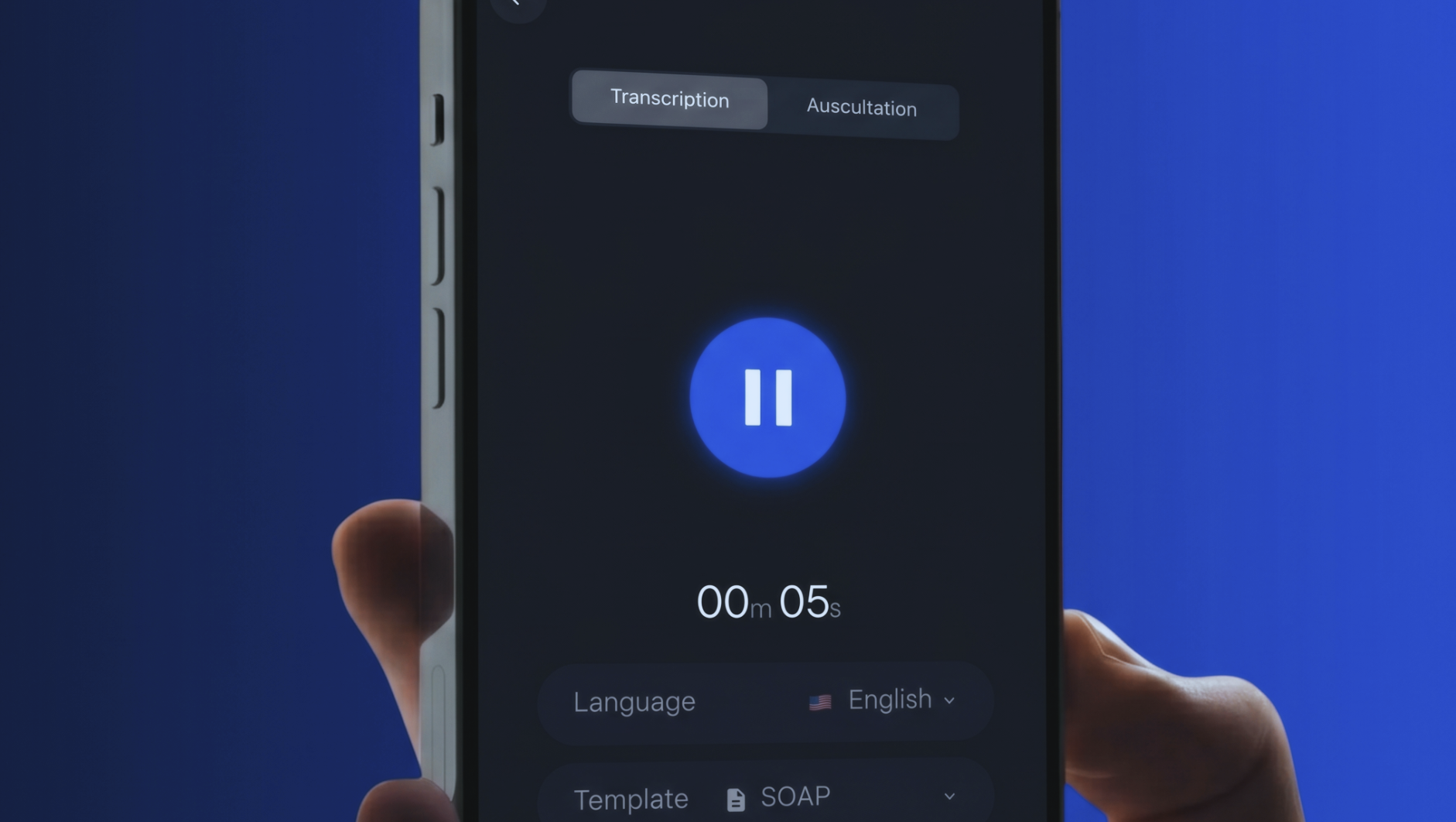
An ambient AI Scribe is not one model. It is a chain: sound is captured, converted into a transcript by speech recognition, and then summarized into a structured clinical note by a large language model. A failure at any link corrupts everything downstream, and each link fails in a characteristic way.
It helps to see where the technology came from. Older automated speech-recognition dictation systems carry error rates of roughly 7% to 11%, driven, as the npj Digital Medicine authors note, by the complexity of medical jargon and by accent variability. Modern ambient scribes built on large language models report lower overall error rates, around 1% to 3%, but they introduce entirely new failure modes that did not exist in simple dictation: AI hallucinations, misattribution, and contextual misinterpretation. The npj authors define a hallucination precisely as AI-generated content that appears plausible but has no basis in reality. A lower error rate is not the same as a safe note, because the new errors are the kind that read perfectly while being wrong.
Three failure modes matter most.
The first is poor input. If the audio is noisy, distant, or low fidelity, the speech-recognition layer mishears, and the language model then confidently summarizes words the patient never said. The accent and jargon sensitivity that the literature documents is fundamentally an input-quality problem.
The second is misattribution, also called speaker confusion. In a room with a patient, a clinician, a family member, and ambient noise, the system may transcribe a sentence correctly but assign it to the wrong speaker. "Denies chest pain" attached to the wrong person is not a typo. It is a clinical error.
The third is contextual misinterpretation, where social conversation bleeds into the clinical record. The scribe hears the entire encounter, including the small talk, and a language model optimized to produce a coherent, complete note can promote a casual remark into a documented symptom. This is the same underlying flaw seen elsewhere in clinical AI: the model is built to generate fluent, plausible text, so it fills gaps with what should be there rather than only what was actually there.
How Keikku is engineered against each failure mode
Keikku treats these failure modes not as unavoidable costs of using AI, but as engineering problems to be solved at each layer of the pipeline. The approach differs depending on whether a clinician is using Keikku as software only or as software paired with the device, and both are deliberate.
Software-only: solving the failures in the model layer
When Keikku runs as pure software on a phone or browser, it attacks the three failure modes directly.
Against misattribution, Keikku uses speaker recognition, also called diarization, to separate who is speaking. By distinguishing the clinician from the patient and from others in the room, the system keeps statements attached to the right person, which is the core defense against the speaker-confusion errors the literature flags.
Against contextual misinterpretation, Keikku runs a contextual agent whose job is to separate social conversation from clinical events, so that a comment about a patient's weekend does not become a documented symptom. This is a direct countermeasure to the failure mode where ambient small talk contaminates the note.
Across the whole output, Keikku applies guardrails designed to constrain the language model from generating unsupported content, the plausible-but-baseless text that defines a hallucination. And rather than silently accepting a generated physical examination, Keikku reviews and prompts the clinician to clarify examination findings, so the exam in the note reflects what the clinician actually did rather than a pattern-completed template.
Software-plus-hardware: solving the failure at the source
The most elegant fix for a pipeline error is to prevent it from entering the pipeline at all. The single largest upstream cause of scribe error is poor input quality, and that is precisely what the Keikku device addresses. Paired with the hardware, Keikku captures the best possible input data, giving the speech-recognition and language layers a clean, high-fidelity signal to work from instead of a noisy one. The cleaner the input, the fewer errors propagate downstream. This is augmentation working at the level of physics, not just software: better capture means a better transcript means a safer note.
The most important safeguard is keeping the clinician in the loop, and making that effortless
Every serious analysis of AI scribes converges on the same conclusion. The npj Digital Medicine authors, like the broader peer-reviewed literature, treat clinician review and final sign-off not as an optional nicety but as an essential safeguard. The signing clinician remains responsible for the accuracy of the note. No amount of model improvement removes that responsibility, and it should not.
The problem is that "review everything" is easy to say and hard to do when the review experience is clunky. A safeguard that is painful to use is a safeguard clinicians will eventually skip. So Keikku treats the human-in-the-loop step as a design challenge, not just a compliance checkbox. Keikku delivers a world-class user experience built to make reviewing, editing, and deploying a note feel effortless rather than burdensome. Editing is fast and conversational. Verifying a finding is simple. And deploying the finished note to the Electronic Health Record (EHR) is frictionless whether or not a direct EHR integration is in place, so the clinician's journey from encounter to signed note feels smooth in every setting.
This is the whole philosophy made concrete. The research is unambiguous that AI scribes fail in specific, characterizable ways, and that the clinician is the safeguard. Keikku engineers against each failure mode at the layer where it occurs, in software through diarization, guardrails, a contextual agent, and examination clarification, and in hardware through superior input capture. Then it makes the one irreplaceable safeguard, the physician in the loop, something clinicians actually want to use. The intelligence does the heavy lifting. The clinician stays in control. And the experience is built so that staying in control never feels like extra work.
Sources
- Topaz M, Peltonen LM, Zhang Z. "Beyond human ears: navigating the uncharted risks of AI scribes in clinical practice." npj Digital Medicine, 2025. nature.com/articles/s41746-025-01895-6
- JMIR Medical Informatics. "AI Scribes in Health Care: Balancing Transformative Potential With Responsible Integration." 2025. medinform.jmir.org/2025/1/e80898
- American Medical Association. "AI scribe saves doctors an hour at the keyboard every day." ama-assn.org