"Healthcare AI" has become a category so broad it has nearly stopped meaning anything. A scribe vendor, a radiology reader, a triage chatbot, and a patient reminder bot all claim the same label, yet they solve completely different problems at completely different points in the clinical workflow. For any clinical leader trying to actually augment a care team, the first useful step is to stop treating AI as one thing and start mapping it to the work.
By Jhonatan Bringas Dimitriades, MD, MD | Augmented by Keikku AI
There are four broad types of Artificial Intelligence (AI) that meaningfully enhance medical practice. Each maps to a distinct part of the clinician's day. Understanding them is the difference between buying a pile of disconnected tools and building a genuinely augmented clinical team.
1. Documentation AI
This is the most mature and most widely adopted category, because it attacks the single largest source of clinician burnout: the note. Documentation AI covers Voice AI that converts the spoken encounter into text, Automated Documentation that structures that text into SOAP notes with ICD-10 and CPT codes, and Generative AI (GenAI) for clinicians that drafts referrals, summaries, and patient instructions.
The promise is straightforward. Physicians lose close to a third of the clinical day to the Electronic Health Record (EHR). An ambient AI Scribe gives that time back. Done well, the clinician stops being a data entry clerk and returns to being a physician. Done poorly, it produces hallucinated notes that take longer to correct than to write. The bar for this category is high precisely because it touches the legal medical record.
2. Clinical Decision AI
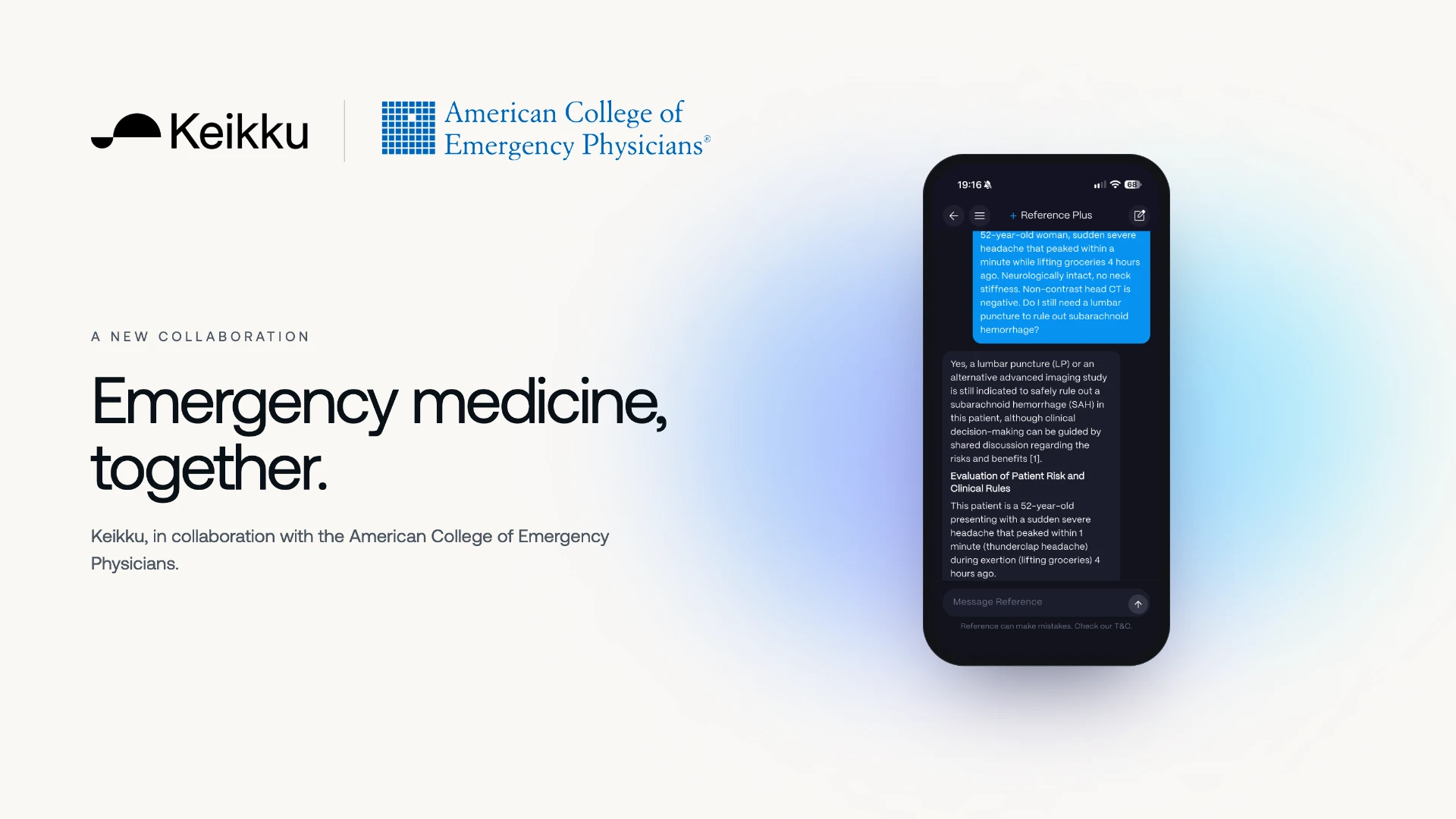
Where documentation AI captures what happened, Clinical Decision AI helps decide what to do next. This category spans Clinical Decision Support (CDS), Evidence Search that returns referenced answers to clinical questions, clinical chatbots, autonomous agents, broader care AI, and Triage AI that routes patients to the right level of care.
The value here is cognitive. No clinician can hold three million papers in their head, and guidelines shift faster than any one person can track. Good Clinical Decision AI brings the relevant, sourced evidence to the point of decision, ideally aware of the specific patient rather than answering in the abstract. The risk is the opposite of documentation: confident answers without citations, or recommendations divorced from the patient actually in front of the clinician.
3. Diagnostics AI
This is the category that pure software cannot reach on its own, because diagnosis often depends on signal the keyboard never sees. Diagnostics AI includes Electrocardiogram (ECG) interpretation, AI Auscultation that analyzes heart and lung sounds, Voice Biomarkers that infer health state from speech, Radiology AI that reads imaging, and Lab AI that interprets results.
What unites this category is that it turns a physical or physiological signal into structured clinical insight. AI Auscultation, for example, can flag a murmur in real time during the exam rather than relying on the clinician's ear alone. The defining constraint is that most diagnostic AI needs a capture device. You cannot analyze a heart sound you never recorded. This is why diagnostics is where hardware and software stop being separable.
4. Patient Orchestration AI
The fourth category sits around the encounter rather than inside it. Patient Orchestration AI uses bots and agents to handle scheduling, intake, follow up, medication reminders, and the long tail of coordination that consumes administrative staff and falls through the cracks when it doesn't. It is the connective tissue that keeps patients moving through a system without a human manually chasing every step.
This category augments the team as much as the individual clinician. Its impact is felt in throughput, no shows, and continuity of care rather than in any single visit.
The problem: four categories, four vendors, zero shared context
Here is what every clinical leader discovers the moment they start buying. Each category has its own specialist vendors. A scribe company for documentation. An evidence company for decision support. A separate reader for each diagnostic modality. A patient engagement platform for orchestration. Each tool is competent in isolation, and each one is an island.
The clinician becomes the integration layer. They dictate to one app, switch tabs to query another, read an ECG in a third, and check the patient's follow up status in a fourth. The context that should flow between these tools instead lives only in the clinician's head, rebuilt by hand at every step. The augmentation that each tool promised is partly eaten by the cost of stitching them together.
Why Keikku is a source of total enhancement
Keikku is built on a different premise: that the four types of AI should not be four products. They should be one platform with one shared patient context, augmenting the clinical team across the full spectrum of clinical duties.
- Documentation. The Keikku Scribe | AI Notes uses Voice AI and Automated Documentation to produce structured SOAP notes, ICD-10, and CPT codes, with word recognition accuracy in the 98 to 99% range.
- Clinical Decision. Keikku Reference delivers context aware, referenced Evidence Search drawn from 3M+ indexed sources, validated at 93% on USMLE style benchmarks, ad free and unlimited. It functions as Clinical Decision Support (CDS) that knows the patient, not a generic chatbot answering in the abstract.
- Diagnostics. Keikku Diagnostics AI brings AI Auscultation to the exam itself, with Murmur Detection validated at 94% accuracy through our eMurmur partnership, and a roadmap that extends across additional modalities.
- Orchestration. Because the platform already holds the documentation, the decision context, and the diagnostic findings, it is positioned to coordinate the work around the encounter rather than treating orchestration as a disconnected bolt on.
The decisive difference is the shared context. In Keikku, the Scribe captures the encounter, the Diagnostics AI flags findings during the exam, and the Reference engine reasons over both. Each engine makes the others smarter. No stack of four specialist vendors can replicate that interconnection through tab switching, because the context never leaves the clinician's head in that model. In Keikku, the context is the product.
Total enhancement scales as software, as software plus hardware, or both
The final piece is reach. Documentation and Clinical Decision AI can be deployed as pure software to an entire organization at the speed of a login. Diagnostics AI requires a capture device, which is exactly why Keikku pairs its platform with an FDA-Cleared device included in the subscription. A health system can therefore deploy software augmentation broadly and layer hardware enabled diagnostics precisely where the exam justifies it, all on one platform, under one shared patient context, under one clearance.
That is what total enhancement means. Not a single AI feature, and not a drawer full of disconnected tools, but coverage of all four types of medical AI, working as one system, augmenting the entire clinical team. That is why Keikku is a source of total enhancement, and it is the real shape of an augmented clinical practice.