For a decade, the conversation about Artificial Intelligence (AI) in medicine has been stuck on the wrong question. We keep asking whether AI will replace clinicians. It won't, and that framing misses the point entirely. The real story is simpler and more urgent: there are not enough clinicians, there will be far fewer than we need, and the only realistic path to closing that gap is to make every clinician we do have dramatically more capable. That is what clinician augmentation means, and it is the actual reason AI and connected hardware belong in healthcare.
By Jhonatan Bringas Dimitriades, MD, MD | Augmented by Keikku AI
The math doesn't work, and it's getting worse
The numbers are not subtle. The World Health Organization (WHO) projects a global shortfall of roughly 11 million health workers by 2030, an estimate it has revised upward as progress has slowed across most regions. McKinsey's analysis puts the lower bound near ten million and the upper bound far higher. Demand for health workers is set to nearly double from where it stood a decade ago, while supply lags persistently behind. The shortage is most acute in low and middle income countries, but no health system at any income level is insulated.
Two forces drive this. Populations are growing and, more importantly, aging. Older patients carry more chronic conditions, more comorbidities, and more complex care needs per visit. At the same time, the clinical workforce cannot scale at the same rate. Training a physician takes a decade, and you cannot manufacture a cardiologist on demand. The result is a widening structural gap between the care that populations need and the human capacity available to deliver it.
You cannot train your way out of this in time. The only lever that moves fast enough is productivity per clinician, and that is precisely what augmentation delivers.
Burnout is the shortage's quiet accelerant
The workforce gap is made worse by what's happening to the clinicians already in the system. Administrative burden, not clinical complexity, is the leading driver of physician burnout. U.S. primary care physicians would need close to 27 hours in a day to complete all recommended care and administrative tasks, including roughly three hours just for documentation. On average, physicians spend about nine minutes in the Electronic Health Record (EHR) for every fifteen minutes with a patient, losing nearly a third of the clinical day to a screen. The unfinished work spills into evenings as "pajama time."
Burnout doesn't just make clinicians miserable. It pushes them out of the profession, which deepens the shortage, which loads more work onto those who remain. It is a doom loop. Encouragingly, the 2025 sentiment data shows burnout finally declining for a third consecutive year, and surveys point to improvements in AI assisted administrative tooling as a main driver of that shift. In other words, augmentation is already proving it can bend the curve.
What augmentation actually means: the full clinical spectrum
Most healthcare AI products solve one narrow problem. An AI Scribe lifts the documentation burden. An Evidence Search tool answers a clinical question. A Diagnostics AI flags a finding. Each is useful. None, on its own, augments the clinician across the actual shape of their day.
A clinician's work spans a continuous spectrum: gathering and examining, reasoning toward a diagnosis, deciding on a course of action, and documenting and coding all of it. Real augmentation means supporting every point on that spectrum, from Diagnosis (Dx) to Clinical Decision Support (CDS) to administrative work, with tools that share context rather than forcing the clinician to bridge the gaps by hand. This is the difference between a stack of disconnected apps and a genuine platform.
Keikku is built as that platform. Three AI engines work as one:
Scribe | AI Notes. Ambient documentation that listens to the encounter and produces structured SOAP notes, ICD-10, and CPT codes automatically. This is where Voice AI does the heavy lifting, with word recognition accuracy in the 98 to 99% range, so the clinician stops being a data entry clerk and returns to being a physician.
Diagnostics AI. Murmur Detection that analyzes heart and lung sounds in real time, with murmur detection validated at 94% accuracy through our eMurmur partnership. The exam itself becomes a source of structured, AI interpreted clinical signal.
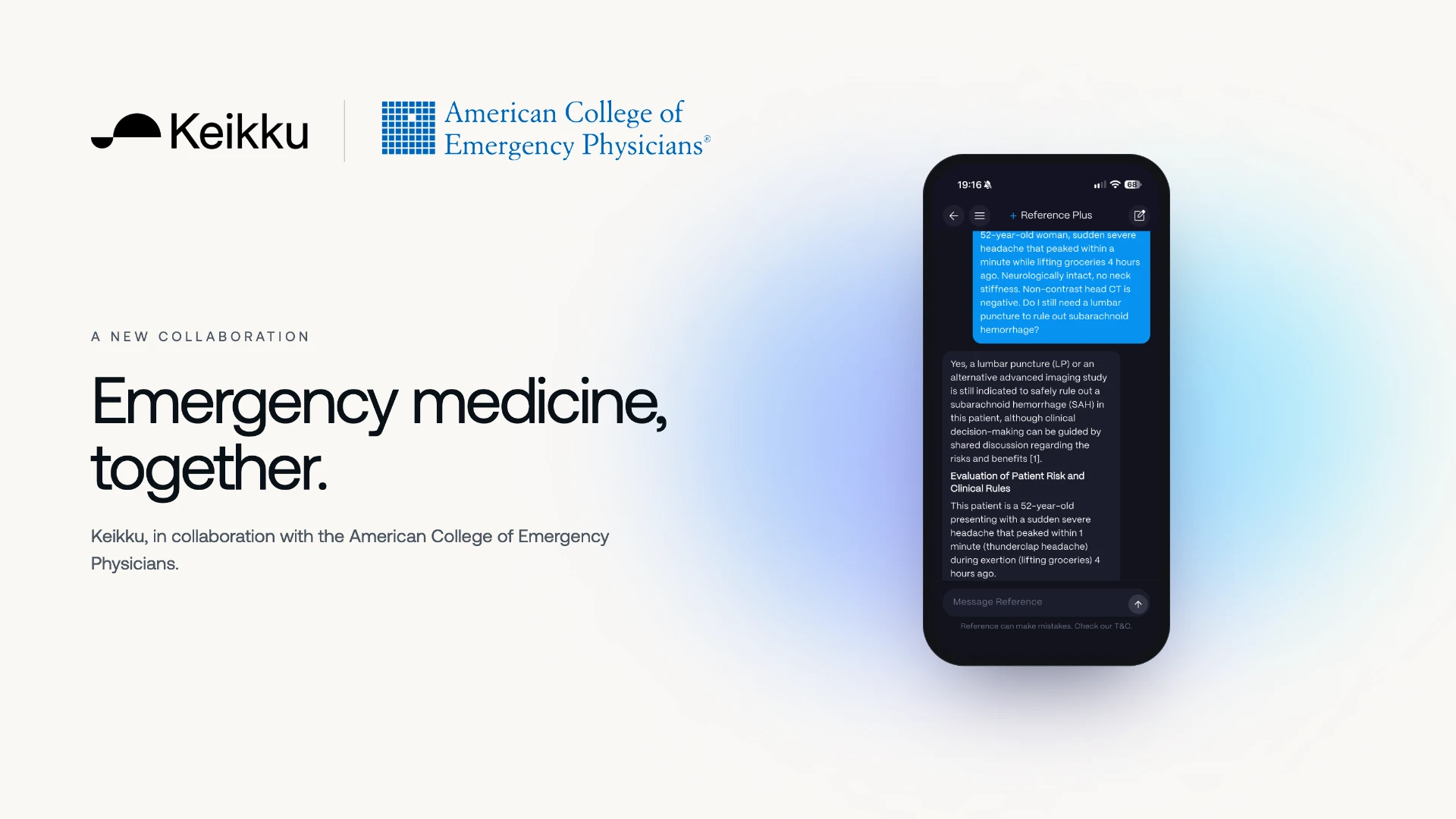
Reference. Context aware, referenced answers drawn from 3M+ indexed sources, validated at 93% on USMLE style benchmarks, ad free and unlimited. Evidence Search that knows the patient in front of you, because it reasons over what the Scribe captured and what the Diagnostics flagged.
The defensible advantage isn't any single engine. It's that the three feed each other. The Scribe captures context, the Diagnostics AI flags findings, and the Reference engine reasons over both. No stack of separate tools replicates that interconnection through tab switching.
Software only or software plus hardware: augmentation that scales either way
Here is where most "AI for healthcare" stories quietly break down. The moment a product depends on a physical device, it becomes hard to scale across a large organization. Procurement, logistics, and per seat hardware costs throttle the rollout. The moment a product is software only, it can't touch the diagnostic exam at all.
Keikku is deliberately built to scale both ways:
Software only. A health system can deploy the Scribe, Reference, and Clinical Decision Support (CDS) to thousands of clinicians as pure software, no device required. Augmentation reaches the entire organization at the speed of a login. Documentation burden drops, evidence is one query away, and CDS travels with every clinician immediately.
Software plus hardware. Where the exam matters, in primary care, cardiology, pediatrics, and remote or rural settings, the FDA-Cleared Keikku device adds Murmur Detection and full Diagnostics AI to the same platform. The hardware is the delivery mechanism for diagnostic intelligence, included with the subscription, not a separate purchase to negotiate.
This is the part organizations underestimate. You don't have to choose between "AI documentation for everyone" and "diagnostic AI for a few." You deploy software augmentation broadly and layer hardware enabled diagnostics exactly where clinical value justifies it, on one platform, with one shared patient context, under one clearance.
The point of the device is the AI, not the other way around
It's worth stating plainly, because the medical device world conditions us to think hardware first. The reason to put intelligence into a connected instrument is not to sell a better instrument. It is to capture clinical signal that pure software can never reach, the actual sounds of a heart and lungs, and route it into the same reasoning system that already handles the notes and the evidence. The device is the how. Clinician augmentation across the full spectrum of clinical duties is the what.
Augmentation is the strategy, not a feature
The shortage is real, structural, and accelerating. Aging populations need more care; the workforce can't grow fast enough; burnout drains the clinicians we have. Against that backdrop, the value of AI in healthcare is not autonomy or replacement. It is leverage, making each clinician capable of safely doing more, with less of their day lost to screens and more of it spent on patients.
That leverage only materializes when augmentation covers the whole clinical spectrum, the Scribe | AI Notes, Diagnostics AI, Reference, Voice AI, Evidence Search, Murmur Detection, and Clinical Decision Support (CDS), and when it can scale across an organization as software, as software plus hardware, or both. That is the case for Keikku, and it is the real reason AI and hardware development belong in medicine: not to take the clinician's place, but to make sure there are enough capable clinicians to go around.