The field optimised the half it could delegate. That constraint is gone.
For close to a decade the story about clinician burden has been a story about writing. Notes are too long, notes take too much time, notes follow doctors home. When ambient AI arrived three years ago it inherited that diagnosis whole and aimed at the same target. Write the note faster, write it automatically, get the physician out of the keyboard and back into the room.
The measurements of what physicians actually do inside the record tell a different story, and it has been sitting in the literature the entire time.
The actual truth of clinician time
Start with the encounter itself. Overhage and McCallie published a descriptive study covering approximately 100 million patient encounters across 155,000 US physicians in 417 health systems. Physicians averaged 16 minutes and 14 seconds of active record time per encounter.
Chart review accounted for 33 percent of that time. Documentation accounted for 24 percent. Ordering accounted for 17 percent.
Roughly 5.4 minutes per encounter reading the record, against roughly 3.9 minutes writing it. The specialties where history matters most carry the heaviest load. Gerontology, endocrinology, primary care and internal medicine ran highest, at 18 to 22 minutes of total record time per encounter.
Lets continue with the time before and after the encounter, the pajama time.
Young and colleagues observed 982 family medicine visits with a stopwatch in the room. Mean visit length was 35.8 minutes, of which 16.5 minutes was face to face. Physicians spent 2.9 minutes in the chart before entering the room, 2.0 minutes in the record while in the room, 7.5 minutes of non-face time, and 6.9 minutes of work outside normal clinic hours. Total record time per visit came to 18.6 minutes, which exceeded the time spent with the patient.
The after-hours portion there is documentation-heavy, and that matters. Pajama time skews toward finishing notes. But pre-visit reading is not trivial at nearly three minutes per patient, and an after-hours task analysis of primary care pediatricians found that viewing patient data was the most frequent after-hours review action, at more than 13 minutes per physician per workday against roughly one minute on documentation templates.
| Activity | Approximate minutes per day |
|---|---|
| Documentation | 84 |
| Chart review of notes | 60 |
| Results review (estimated half of refills and results) | 27 |
| Chart review total | 87 |
Roughly 87 minutes a day reading the record. Roughly 84 minutes a day writing it. At around 20 visits per day that is about 4.4 minutes per patient spent reading against about 4.2 minutes per patient spent writing.
So the honest conclusion is not that reading dominates. It is this. Across the full day, counting time inside the consultation and the hours on either side of it, the two burdens are the same size.
Why documentation became the target
The field did not choose documentation because it was the bigger problem. It chose documentation because it was the only part of the burden that got smaller when you handed it to somebody else.
Look at what transcription actually costs. The work is capture, it happens in parallel with the consultation, and a second person can do it in real time while the physician talks. Verification is cheap. The doctor reads a note about a conversation they had ninety seconds ago and knows immediately whether it is right. Hand off ten minutes of work, spend thirty seconds checking it. That arithmetic is why scribes worked, and they did work.
Now run the same arithmetic on chart review. The work is not capture, it is judgment. A second person reading nine years of record takes at least as long as the physician would, and usually longer, because they do not yet know what they are looking for. Knowing what to look for requires knowing what the patient is presenting with, which requires being in the room. And when the summary comes back, the physician still has to open the chart to trust it, because the risk is never what the summary says. It is what the person that took the task might have not seen or skipped. Verification costs as much as the original task. Hand off twenty minutes of work, spend twenty minutes checking it.
Delegation only returns time when checking is cheaper than doing. For transcription it is. For clinical synthesis it never was.
What the reading is failing to catch
Time is the burden argument. The safety argument is what the time fails to buy.
Smith and colleagues surveyed primary care clinicians and found missing clinical information in 13.6 percent of visits: laboratory results, letters, radiology, history and examination, medications. More than half of it sat outside the clinician's own system but within the country. It existed. It was simply somewhere else. Clinicians judged 44 percent of it likely to adversely affect the patient. In the NHS replication, a fifth of those consultations ended with the clinical decision made anyway, the gap still open.
Not because anyone is careless, but because the alternative is a clinic running forty minutes behind and a patient in front of you who needs an answer today.
The extreme case
Emergency physicians show what happens when the time compresses. Iscoe and colleagues found a median of 6.82 minutes of record time per encounter, of which documentation took a median of 3.72 minutes and review took a median of 1.05 minutes.
One minute of chart review, on an undifferentiated patient, with no prior relationship. In family medicine, where the physician has a panel and a preparation window, it was 2.9 minutes before the patient walked in.
A systolic murmur in a 40 year old is noise. The same murmur in someone who had rheumatic fever at twelve, or Kawasaki at four, is a different disease with a different urgency. The finding is identical. The meaning is not, and the meaning sits in a record the clinician has ninety seconds to search.
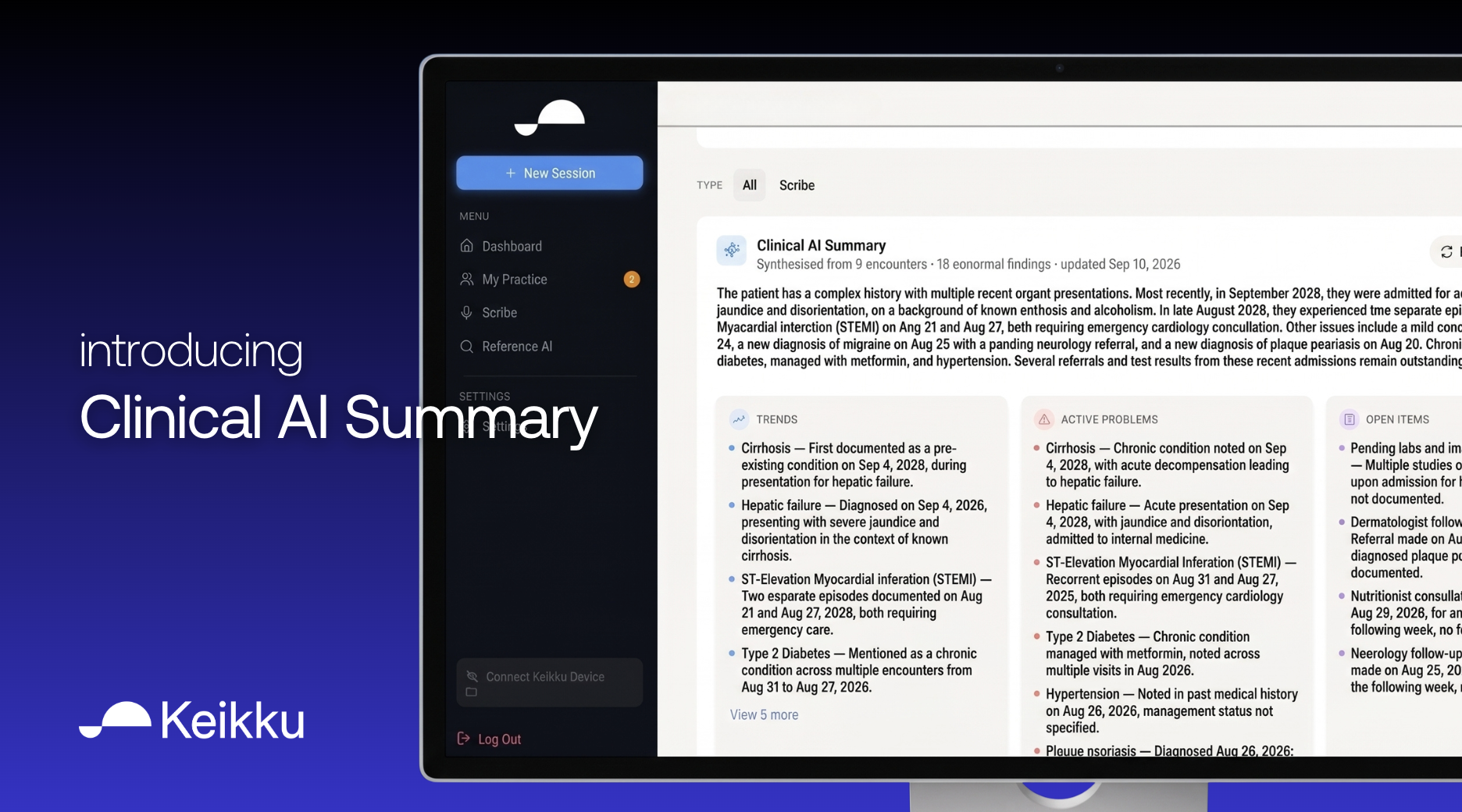
Introducing Keikku Clinical Summaries
Delivering time back to clinicians without putting clinical quality at risk.
At Keikku we build tools that let clinicians perform at their best, powered by AI that holds the highest quality certifications. We are launching Clinical Summaries because in a system where every clinician carries more patients than the one before, saving time cannot come at the cost of quality or of clinical certainty. Those two things have been treated as a trade for as long as the problem has existed. A clinician should be able to walk into a room already knowing their patient, and know it with the same confidence as if they had read every single line of the chart.
Sources
Overhage JM, McCallie D Jr. Physician Time Spent Using the Electronic Health Record During Outpatient Encounters: A Descriptive Study. Ann Intern Med. 2020;172(3):169-174.
Arndt BG, Beasley JW, Watkinson MD, et al. Tethered to the EHR: Primary Care Physician Workload Assessment Using EHR Event Log Data and Time-Motion Observations. Ann Fam Med. 2017;15(5):419-426.
Young RA, Burge SK, Kumar KA, Wilson JM, Ortiz DF. A Time-Motion Study of Primary Care Physicians' Work in the Electronic Health Record Era. Fam Med. 2018;50(2):91-99.
Sinsky C, Colligan L, Li L, et al. Allocation of Physician Time in Ambulatory Practice: A Time and Motion Study in 4 Specialties. Ann Intern Med. 2016;165(11):753-760.
Smith PC, Araya-Guerra R, Bublitz C, et al. Missing Clinical Information During Primary Care Visits. JAMA. 2005;293(5):565-571.
Missing Clinical Information in NHS hospital outpatient clinics: prevalence, causes and effects on patient care. BMC Health Serv Res. 2011;11:114.
Iscoe M, et al. Exploration of Electronic Health Record Patterns of Emergency Physicians. JAMA Netw Open.
Rule A, et al. Length and Redundancy of Outpatient Progress Notes Across a Decade at an Academic Medical Center. JAMA Netw Open. 2021.
Downing NL, Bates DW, Longhurst CA. Physician Burnout in the Electronic Health Record Era: Are We Ignoring the Real Cause? Ann Intern Med. 2018;169(1):50-51.
Characterization of Electronic Health Record Use Outside Scheduled Clinic Hours Among Primary Care Pediatricians. JMIR Med Inform. 2022;10(5):e34787.