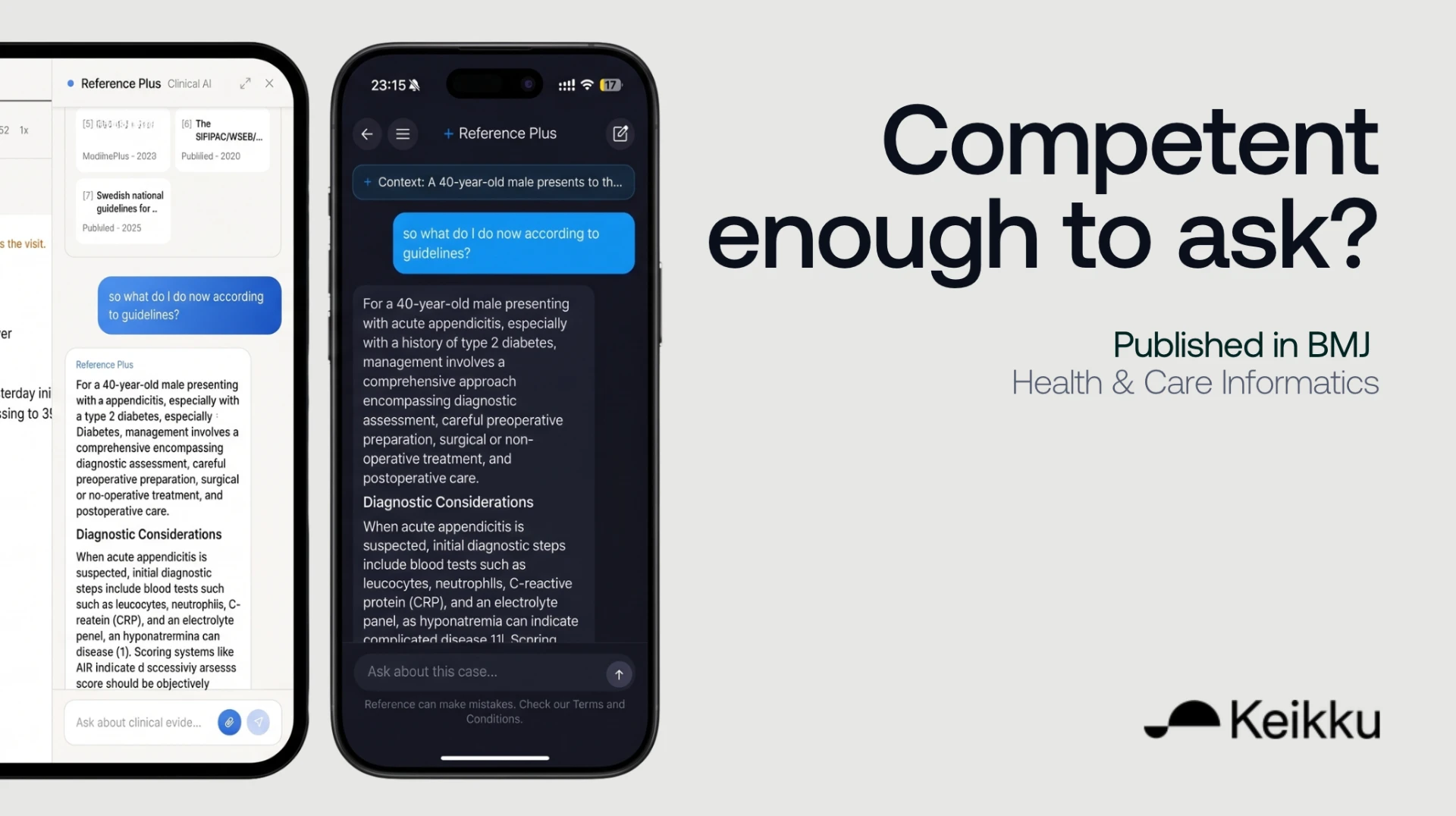
Published in BMJ Health & Care Informatics: Engineering framework for curiosity-driven and humble AI in clinical decision support, BMJ Health Care Inform. 2026;33(1):e101877.
LLMs are excellent at giving a plausible answer to everything. In medicine, that currently carries major risks, and the biggest is that a fluent, confident answer can be entirely false. The danger peaks when information is missing: instead of asking, the model fills the gap.
BODHI, which stands for Balanced, Open-minded, Diagnostic, Humble, and Inquisitive, is a framework co-authored by our Head of AI, Felipe Ocampo Osorio. This model and the critical thinking behind it are beginning to shape our innovation at Keikku. It guides a model to break its uncertainty into specific dimensions, seek the missing context, and defer to clinical judgment when it matters.
How BODHI works
BODHI rests on a dual reflective architecture. First, the model decomposes its epistemic uncertainty into task specific dimensions: what it does not know, which dimension of the case the gap sits in, and how much that gap could change the decision. Second, it constrains its own responses using virtue based stance rules derived from a Virtue Activation Matrix, deciding when to answer, when to ask, and when to defer to clinical judgment.
The result is a model that behaves less like an answer machine and more like a colleague who knows the limits of their own knowledge.
What the evaluation found
The paper evaluated the framework on 200 clinical vignettes from HealthBench Hard, testing GPT-4o-mini and GPT-4.1-mini across 5 random seeds, for 2000 total observations.
For one of the models tested, responses that asked appropriate clarifying questions went from 7.8% to 97.3%, and overall clinical response quality rose by 16.6 percentage points. On the other model, appropriate clarifying questions went from 0.0% to 73.5%.
The framework did not make the models smarter. It made them honest about the boundaries of what they know, and it taught them to gather what was missing before answering.
Competence is knowing when you do not know
When a case is complex, a competent clinician asks whether they know enough. An AI in a clinical workflow should do the same, and flag when uncertainty could change a decision.
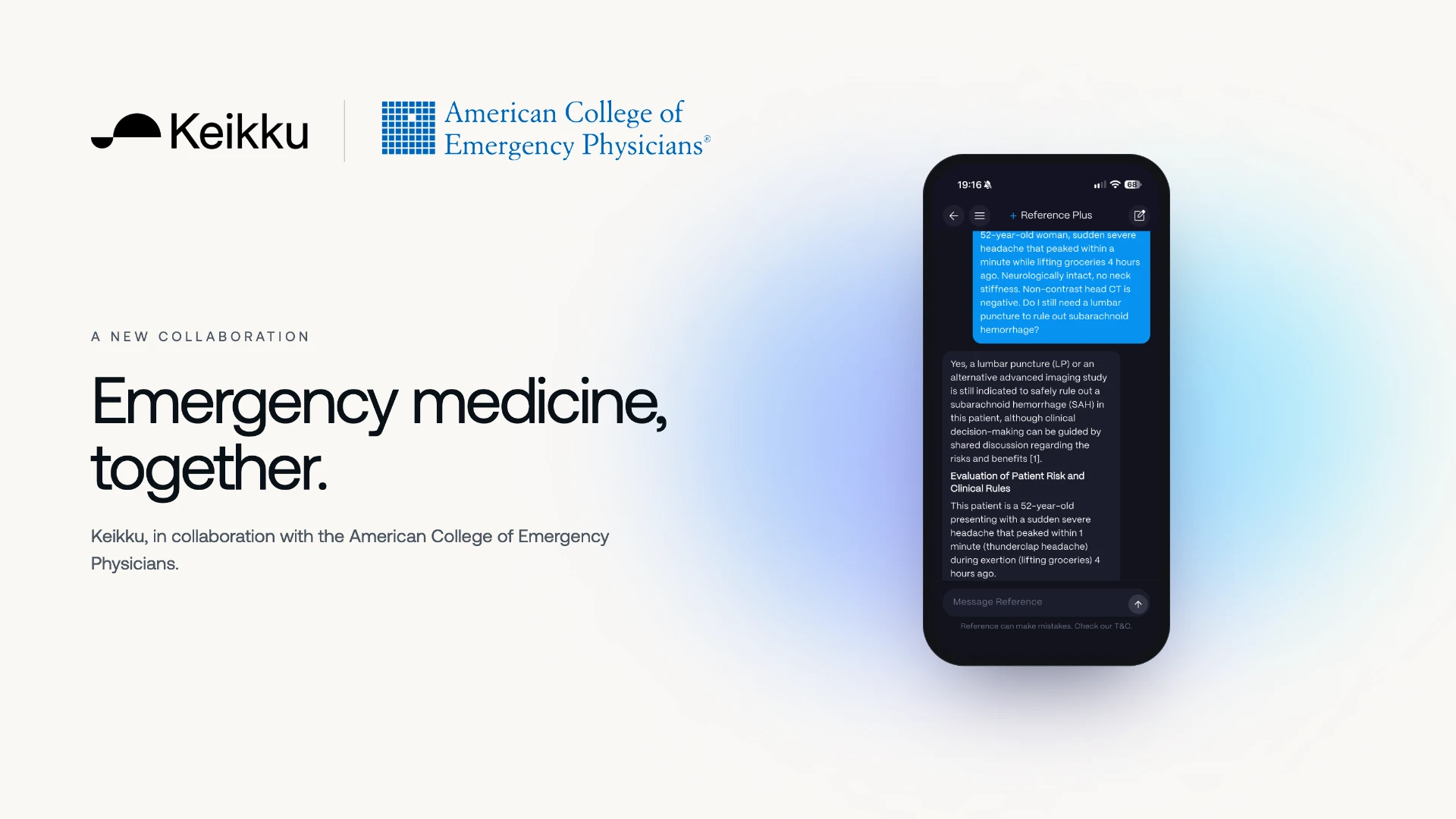
Keikku Reference and its frameworks are being designed to show competence the way clinicians do: by flagging uncertainty instead of hiding it.
At Keikku, we believe credible frameworks for clinical decision support are what keep clinicians in the loop, able to see how an answer was reached and decide whether to act on it.
Show your reasoning. Especially when you're not sure.
Sources
Arslan J, Benke K, Cajas Ordóñez SA, Castro R, Celi LA, Cruz Suarez GA, Delos Reyes R, Engelmann J, Ercole A, Hilel A, Kinyera L, Lange M, Lunde TM, Meni MJ, Ocampo Osorio F, Premo AE, Sedlakova J, Vig P. Engineering framework for curiosity-driven and humble AI in clinical decision support. BMJ Health Care Inform. 2026;33(1):e101877. Full text. DOI: 10.1136/bmjhci-2025-101877