Updated July 2026
AI medical scribes have moved from pilot projects to core clinical infrastructure across Europe in 2026. Health systems from the NHS to the Nordics report clinicians saving up to two hours daily on documentation, and the conversation has shifted from whether to adopt ambient AI to which platform fits a given practice, specialty, and regulatory environment.
Europe is a distinct market. Fragmented EHR landscapes, multilingual clinical environments, GDPR, and the EU Medical Device Regulation (MDR) all shape which tools can be deployed and how. A growing number of vendors now position their products as regulated medical devices rather than unregulated productivity software.
But the more important shift in 2026 is conceptual. The best tools are no longer just scribes. The category is splitting into two kinds of product: tools that take notes, and clinical AI platforms that take notes, support diagnostics, and answer clinical questions. This guide compares the leading options for European clinicians on that basis, examining what each one actually is, its regulatory status, its hardware, its evidence capabilities, and where it fits.
Scribe, Platform, or Multimodal Platform
The single most useful question to ask of any tool in this market is simple: does it only document, or does it do more?
Most of the platforms here are scribes. They listen to the consultation and produce a structured note. That is genuinely valuable, and the best of them do it very well. But a note is where they stop.
Two go further and are better understood as platforms rather than scribes. Both connect a scribe to a referenced evidence engine; the difference is the third engine. Heidi's AI Care Partner adds patient communications, wrapping the scribe in a wider workflow around the note. Keikku's third engine is diagnostics, so it captures not just the conversation but the body: auscultation, murmur detection, and lung sounds, all sharing the same clinical context across a single consult.
The Evidence Question: Notes, or Notes Plus Answers
A second distinguishing lens is whether a platform stops at the note or also delivers referenced clinical answers at the point of care.
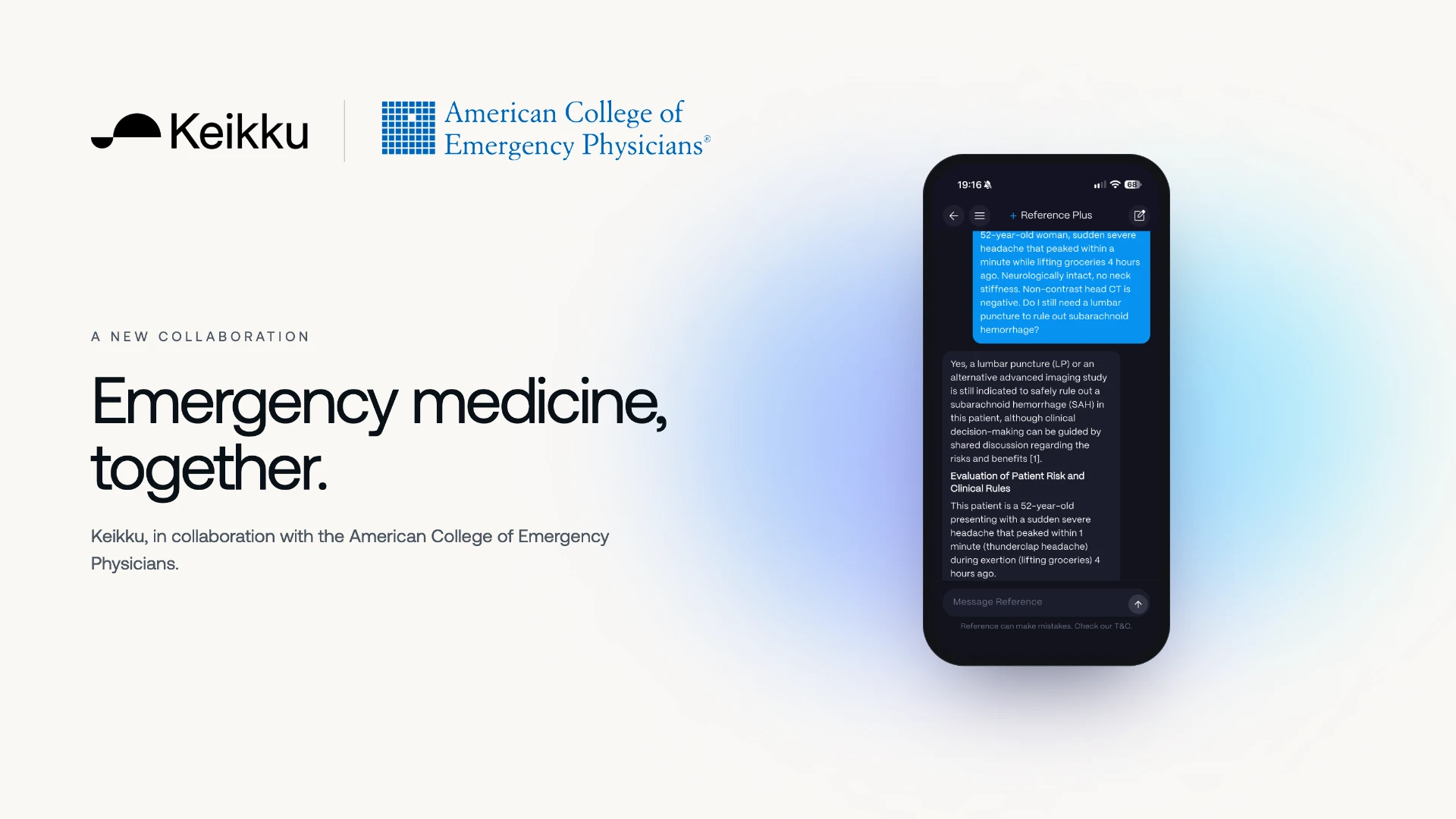
Two platforms carry a dedicated evidence layer. Heidi offers Heidi Evidence, an ad-free, citation-backed decision support layer built on partnerships with sources including NICE, BMJ Group, and HealthPathways, with a premium Evidence tier for the deeper source set. Keikku Reference offers a referenced answers engine drawing on more than 3 million sources, delivered ad-free, and, crucially, context-aware: because it sits inside the platform, it already knows the patient from the scribe and the diagnostics.
Free. Unlimited. Ad-free. Just evidence.
The remaining platforms, Tandem, Tortus, Noteless, and Autoscribber, are documentation-first. Tandem is extending into coding and clinical decision support, but the point-of-care evidence layer is most fully realized in Heidi and Keikku.
The Hardware Tier
Every platform here starts as software. A clinician downloads an app, runs it on a phone or laptop, and begins documenting with no device required. That is true of Keikku, Heidi, and Tandem just as it is of the software-only scribes. Where these three differ is that each also offers an optional hardware tier, a dedicated capture device a clinician can add once they want cleaner audio or more capability. It is worth understanding what that tier actually is in each case, because the three devices are not the same kind of thing.
Heidi and Tandem offer capture microphones. Heidi Remote is a 21-gram lapel microphone that captures audio on-device and syncs to the Heidi platform, a purpose-built ambient microphone whose own regulatory classification as hardware remains unconfirmed. Tandem offers the Philips SpeechMike Ambient, a professional-grade wearable dictation microphone with a four-microphone beamforming array and patented speaker separation. Both are excellent ambient capture devices. But they are microphones, engineered to a professional standard, accessories that improve the audio feeding an otherwise software product, and both are sold separately.
Keikku's hardware tier is a different kind of device. The FDA-cleared Keikku Device is more than a microphone. It is an omnidirectional ambient microphone system for clean capture in noisy rooms, it is voice-operated so the clinician can trigger functions hands-free ("Hey Keikku") without touching a screen, and it performs AI auscultation. The Keikku Device captures the conversation, listens to the body, and responds to voice. None of the microphone-only devices offer voice control or diagnostics. And rather than being a separate purchase, the Keikku Device is included with the Keikku AI Suite subscription.
Tortus, Noteless, and Autoscribber are software-only, with no hardware tier.
The Platforms Compared
Keikku (Lapsi Health): The Only True AI Medical Assistant
What it is: A multimodal clinical AI platform. Built by physicians at the Dutch-American medtech company Lapsi Health, Keikku is the only platform in this comparison that combines Scribe | AI Notes, Murmur Detection, and Reference in one system, the only one whose engines reach into the physical exam as well as the note. Other assistants take notes; Keikku takes notes, flags diagnostics, and gives referenced clinical answers. The AI is the product. The FDA-cleared device is how it is delivered.
The three pillars:
- Scribe | AI Notes for ambient documentation, structured SOAP notes, ICD-10 and CPT codes.
- Keikku Reference for referenced answers from more than 20 million sources, ad-free, and context-aware, so it reasons over the patient the scribe and diagnostics already captured.
- Hardware, an omnidirectional ambient microphone system for clean capture in noisy rooms, voice-operated ("Hey Keikku"), and an AI auscultation device.
The key differentiator is that these three engines feed into one another. The scribe captures context, the diagnostics flag findings, and the evidence engine reasons over both. No competitor connects all three.
Deployment, software-first: Clinicians typically start software-only, running the Scribe and Reference on a phone or laptop with no device required. When they want the full platform, clean ambient capture, hands-free voice control, and AI auscultation, they transition to software-plus-hardware. The Keikku Device is included with the Keikku AI Suite subscription, not sold separately.
Hardware: The Keikku Device is a purpose-built omnidirectional ambient microphone system with on-device edge computing, active noise suppression, up to 72 hours of battery life, and a clinical-grade acoustic sensor. It is voice-operated and FDA-cleared as a Class II medical device. It operates in three modes: Ambient (clean capture, feeding the scribe), Voice Commands (hands-free control, unique to Keikku here), and Auscultation (AI analysis of heart and lung sounds).
Design: Keikku is also the best-looking product in the category. Its brand identity and app design won a European Design Award. In a field of clip-on microphones and dictation dongles, the Keikku Device is the one object designed to be seen on a clinician's desk.
Regulatory: FDA-cleared Class II. HIPAA, ISO 13485, GDPR. The Scribe carries CE MDR Class I self-declaration, with an ongoing CE MDR Class IIa certification for the Device.
Best for: General practice, internal medicine, pediatrics, cardiology, pulmonology, emergency medicine, physiotherapy, private practices, and any noisy clinical environment. Works software-only for pure documentation and telehealth, and expands to the full multimodal platform for clinicians who examine as well as document.
Pros:
- The only platform that combines documentation, diagnostics, and clinical evidence, with the three engines sharing context.
- Software-first, so clinicians start with no hardware and add the device only when they want it.
- Voice-operated. Hands-free control is unique to Keikku among the platforms here.
- Device included with the Keikku AI Suite subscription rather than a separate purchase.
- Award-winning design and an FDA-cleared Class II device.
Cons:
- The full multimodal value is realized once a clinician adopts the device; software-only users get the scribe and evidence but not diagnostics.
- CE MDR Class IIa for the Device is in progress rather than complete.
Heidi (Heidi Health): Best Broad Care-Partner Platform
What it is: A Melbourne-based clinical AI company whose scribe is used in millions of patient interactions weekly, widely adopted across the UK, Australia, and the US. Heidi is a genuine platform, not just a scribe: its "AI Care Partner" spans documentation, referenced evidence, and patient communications, extending outward from the note into the surrounding workflow. Its one gap relative to Keikku is diagnostics; Heidi captures and coordinates around the conversation, but does not reach into the physical exam.
Hardware: Heidi Remote, launched March 2026. A 21-gram lapel microphone with on-device transcription, up to 14 hours of battery life, encrypted local storage, and offline capture. It is a capture accessory, sold separately, and its own classification as a device is unconfirmed.
Evidence: Yes. Heidi Evidence, an ad-free, citation-backed decision support layer with partnerships including NICE and BMJ Group, with a premium Evidence tier for the deeper source set.
Regulatory: The Heidi scribe is positioned as a Class I medical device under CE MDR (self-declared). ISO 27001 certified, SOC 2 compliant, and built to meet GDPR, HIPAA, and PIPEDA.
Best for: Multi-market and multilingual practices, primary care, allied health, and teams wanting documentation, evidence, and patient communications from one vendor.
Pros:
- Broadest scribe platform: documentation, evidence, comms, and a capture accessory.
- Strong multilingual support and enormous adoption.
- On-device transcription reduces latency and connectivity dependence.
Cons:
- No diagnostics. The Remote captures the room, not the body.
- Clinician-tier pricing has risen with the 2026 rebrand and sits at the premium end.
- EHR write-back and a signed BAA are gated behind higher tiers.
Tandem Health: Best European-Native Regulated Scribe
What it is: A Stockholm-based scribe used by more than 5,000 care organizations across Europe, built for European healthcare from the outset, with data processed within Europe and integration into more than 100 European medical record systems.
Hardware: Tandem pairs with the Philips SpeechMike Ambient, a professional-grade wearable microphone with a four-microphone beamforming array, patented speaker separation, and medical-grade materials. A best-in-class capture microphone, sold as a separate Philips product, not a medical device in its own right.
Evidence: Emerging. Tandem is extending into a Coding Assistant and Clinical Decision Support (both Class IIa), but does not yet offer a standalone point-of-care evidence product on the level of Heidi Evidence or Keikku Reference.
Regulatory: The strongest CE MDR position among the scribes here. Tandem's AI Scribe and Coding Assistant are both marked as EU MDR Class IIa medical devices, externally assessed by a notified body, and the AI Scribe was the first in Europe to reach that classification. Also ISO 27001 and ISO 13485 certified.
Best for: European health systems and clinics prioritizing the highest MDR classification, deep European EHR integration, and in-Europe data processing.
Pros:
- Highest regulatory bar of the scribes: Class IIa for both Scribe and Coding.
- Built natively for the fragmented European EHR and multilingual landscape.
- One-click transfer into more than 100 European record systems.
Cons:
- Documentation-first, no diagnostics and no standalone evidence product yet.
- The SpeechMike Ambient is a separate hardware purchase at professional pricing, and it is a microphone, not a clinical instrument.
Tortus: Strong UK-Native, Governance-Focused Scribe
What it is: A London-based ambient AI assistant proven at scale across the NHS, with over 2.5 million consultations recorded and a deep governance and clinical-safety story. Its product, OSLER, listens, drafts notes and letters, and suggests clinical codes. Software-only.
Hardware: None.
Evidence: No dedicated point-of-care evidence layer. The focus is documentation, coding, and clinical-safety governance.
Regulatory: Tortus recently became the first ambient voice technology to achieve UKCA Class IIa certification, upgraded from an earlier Class I registration. Note that UKCA is the UK marking, distinct from EU CE MDR. ISO 13485 certified and built to NHS England's AVT standard.
Best for: NHS trusts and UK practices prioritizing regulatory rigor, clinical-safety governance, and deep EPR integration.
Pros:
- Strong regulatory and clinical-safety posture, first AVT at UKCA Class IIa.
- Proven at very large scale in the NHS.
- Deep NHS EPR and telephony integration.
Cons:
- UK-centric; UKCA is not an EU CE mark.
- Software-only scribe, no diagnostics and no evidence layer.
Noteless: Fast-Growing Nordic Software Scribe
What it is: An Oslo-based scribe that has grown rapidly across Scandinavia, used by roughly one in four GPs in Norway, with strong multilingual support and expansion into the UK, Germany, and the Netherlands. Documentation-first, GDPR-native, software-only.
Hardware: None.
Evidence: No dedicated evidence layer. Documentation and template personalization are the core.
Regulatory: Positioned as a CE MDR Class I medical device, GDPR-native, with European data handling.
Best for: Nordic and Northern European primary care, physiotherapy, and mental health practices wanting a fast, multilingual, GDPR-native scribe.
Pros:
- Very strong Nordic adoption and rapid growth.
- Broad European language support.
- GDPR-native and built for the European market.
Cons:
- Class I only, below the Class IIa bar set by Tandem and Tortus.
- Documentation-only, no diagnostics and no evidence layer.
Autoscribber: Emerging Entry-Level Scribe
What it is: A lightweight, documentation-only ambient scribe aimed at individual clinicians and small practices getting started with AI documentation. The smallest European footprint of the platforms in this guide. Software-only.
Hardware: None.
Evidence: No.
Regulatory: Limited public regulatory posture relative to the certified platforms above. Prospective users should confirm CE MDR status and a signed data agreement before deployment.
Best for: Solo clinicians and small practices testing ambient documentation for the first time at low cost.
Pros:
- Low barrier to entry.
- Simple, documentation-only workflow.
Cons:
- Least established regulatory and enterprise posture.
- Documentation-only, no hardware, no evidence layer, limited integration depth.
Comparison Table
| Keikku | Heidi | Tandem | Tortus | Noteless | Autoscribber | |
|---|---|---|---|---|---|---|
| Type | Clinical AI platform (Scribe + Diagnostics + Evidence) | Scribe → care-partner | Scribe + coding | Scribe (governance) | Scribe | Scribe (entry) |
| Capture | Software + optional FDA-cleared Device (included) | Heidi Remote mic (sold separately) | Philips SpeechMike (sold separately) | Software-only | Software-only | Software-only |
| Diagnostics | ✓ Auscultation, murmur, lungs | - | - | - | - | - |
| Evidence | ✓ Reference (3M+ sources, ad-free) | ✓ Heidi Evidence | Emerging (Coding + CDS) | - | - | - |
| Regulatory | FDA Class II; CE MDR Class I (Scribe); HIPAA, ISO 13485, GDPR | CE MDR Class I (scribe) | CE MDR Class IIa (Scribe + Coding) | UKCA Class IIa | CE MDR Class I | Limited |
| Best for | GP, cardiology, pulmonology, pediatrics, ER, noisy settings | Multi-market, multilingual, primary care | EU health systems, deep EHR integration | NHS trusts, UK governance | Nordic primary care | Solo clinicians, trials |
A note on capture hardware pricing: the Heidi Remote retails around $299.99 (intro pricing near $224.99), roughly 200 to 280 euros. The Philips SpeechMike Ambient that Tandem partners with retails at roughly $497 to $529, around 450 to 490 euros; confirm the exact model and regional price, since older SpeechMike models are far cheaper. The Keikku Device is included with the Keikku AI Suite subscription, so there is no separate hardware line item.
The 2026 European Ranking
No single tool wins on every axis, and the honest read of the market is that three platforms lead, for different reasons.
Leading tier, a three-way tie: Keikku, Heidi, and Tandem.
- Keikku leads because it is the only multimodal clinical platform in the group. Where Heidi extends outward from the note into evidence and communications, Keikku extends inward into the encounter, combining documentation, diagnostics, and clinical evidence in one system, with the three engines sharing context, delivered through an FDA-cleared Class II device that is also voice-operated. It is software-first, so clinicians start with no hardware and expand into the full platform when ready. It is the only platform here that captures the body as well as the conversation, and the only true AI Medical Assistant.
- Heidi leads on breadth among the scribes. Scribe, Evidence, Comms, and a capture accessory in one care-partner platform, with strong multilingual reach and enormous adoption. It does not do diagnostics.
- Tandem leads on European regulatory rigor. Class IIa for both Scribe and Coding, native European EHR integration, and in-Europe data processing.
Which of the three is right depends on the practice. A clinician who examines patients, in cardiology, pulmonology, pediatrics, general practice, or emergency medicine, will find Keikku's combination of scribe, diagnostics, and evidence decisive, and can start on software before adding the device. A large multilingual group wanting one vendor for documentation, evidence, and comms will lean Heidi. A European health system procuring on the strictest MDR classification will lean Tandem.
Second tier: Tortus. A strong, safety-focused, UKCA Class IIa scribe proven at NHS scale, but UK-centric, software-only, and without diagnostics or an evidence layer.
Third tier: Noteless. A fast-growing, GDPR-native Nordic scribe at Class I, below the leaders on regulatory bar and platform breadth, but a credible regional choice.
Fourth tier: Autoscribber. An entry-level, documentation-only option for a first step into ambient AI, with the least established regulatory and enterprise posture.
How to Choose
Start with one question: do you want a scribe, or a clinical AI platform?
If you only need documentation, any of the scribes here can serve you well; choose on regulatory bar, language coverage, and EHR fit. If you want a broader platform, Heidi and Keikku both go beyond the note. Heidi adds evidence and patient communications around the documentation; Keikku adds diagnostics inside the encounter. If you want documentation plus diagnostics plus referenced clinical answers in one connected system, capturing the body as well as the conversation, Keikku is the one platform in this comparison that delivers all three.
Then consider how you want to start. A software-first platform lets a clinician begin with no hardware, a phone or laptop and the AI, and add the device only when the value is proven. That lowers the barrier to entry compared with buying a separate microphone up front.
Then check the regulatory bar your organization requires. In much of Europe, Class IIa is becoming the expected standard for tools that shape the record. Tandem and Tortus lead here; Keikku's device is FDA Class II cleared with CE MDR Class IIa in progress; Heidi and Noteless sit at Class I.
Finally, weigh total cost, including hardware. A software subscription plus a separate capture microphone is a different budget line from a platform where the device is included in the plan.
The best approach, as always, is to trial your shortlist with real encounters across your actual case mix, measure the editing burden on the generated notes, and confirm the data agreement and regulatory status before committing.
This guide is for informational purposes and should not replace professional judgment or your institution's procurement and information-governance processes. Regulatory classifications, pricing, and product features change quickly in this market; verify current details directly with each vendor before purchase. Sources include vendor materials and public reporting current as of July 2026.