Roughly one in three physician practices now uses an ambient AI medical scribe. The category has matured fast, and the question has shifted from "should we use one" to "which one should we use." This guide compares three of the most discussed options for clinicians evaluating an AI scribe in 2026: Keikku, Heidi Health, and Freed AI. The goal is not to crown a single winner, but to make the trade-offs explicit so you can pick the best AI medical scribe for the way your practice actually works.
By Jhonatan Bringas Dimitriades, MD | Augmented by Keikku AI
What an AI medical scribe is, and what to compare
An ambient AI medical scribe listens to the patient encounter, transcribes it, and drafts a structured clinical note for the clinician to review and sign. Modern scribes report transcription error rates in the low single digits, but raw accuracy is only one of several dimensions that matter at the bedside.
When clinicians ask which is the best AI medical scribe, the honest answer depends on five things:
- Input quality. Software-only scribes depend entirely on the microphone in the room. Anything that improves capture (a dedicated device, a quiet room, a close-talking mic) reduces downstream errors.
- Clinical safety design. Speaker diarization, hallucination guardrails, and how the system handles social conversation versus clinical content.
- Workflow fit. Note templates, EHR delivery, mobile and browser support, multilingual capture.
- Scope of the AI suite. Whether the product is just a scribe, or whether documentation sits alongside an evidence-based reference, voice AI, and diagnostics.
- Regulatory posture. Whether components are cleared by regulators (FDA, ISO, HIPAA, GDPR, VA) versus marketed as wellness or productivity tools.
With that frame, here is how Keikku, Heidi, and Freed actually compare.
Keikku: an AI suite anchored by FDA-cleared hardware
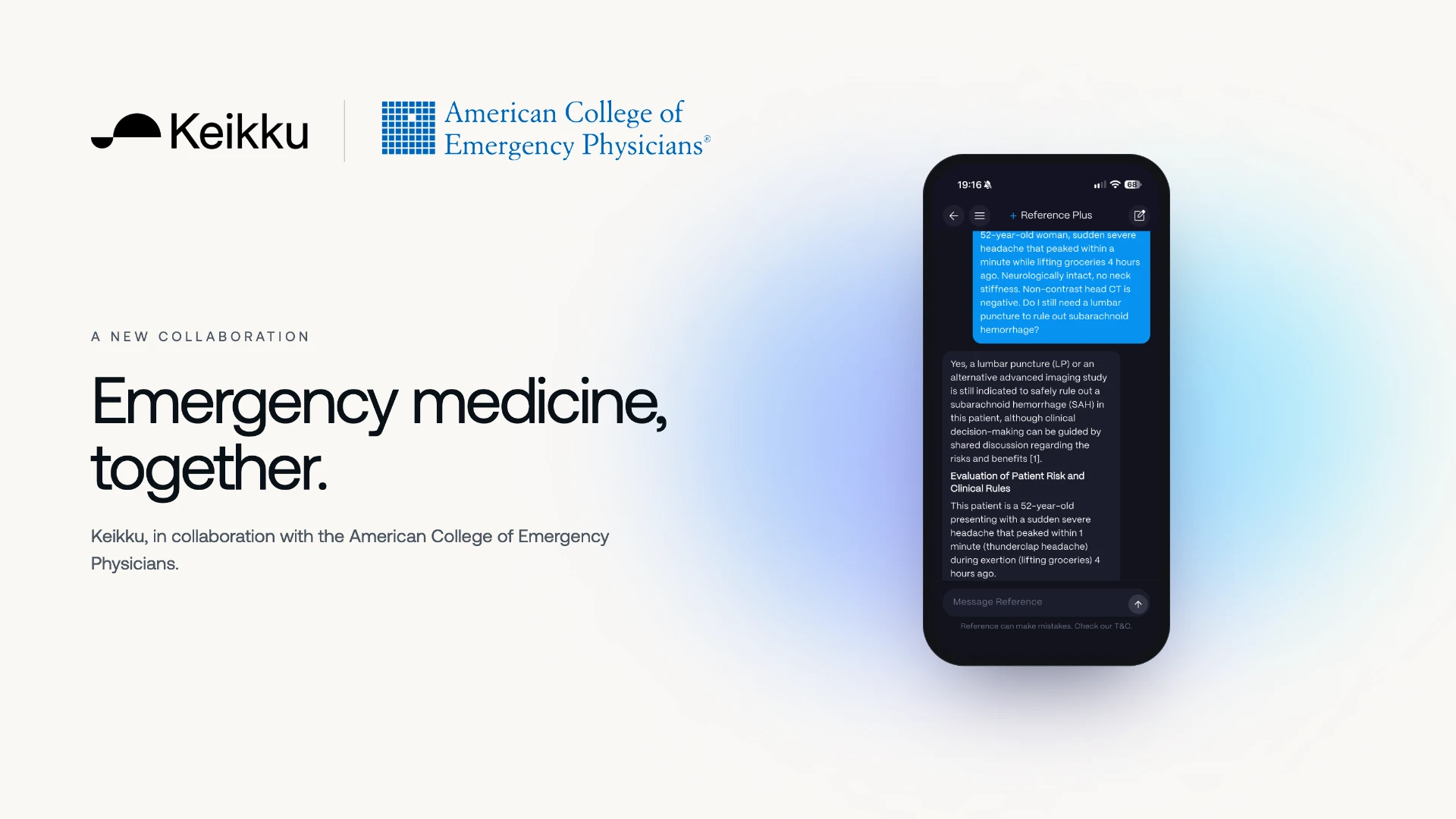
Keikku is built as a clinician augmentation platform, not a standalone scribe. The Scribe | AI Notes module is one engine inside the Keikku AI Suite, alongside Reference (evidence-based Q&A with cited sources), Murmur Detection, and Auscultation AI. All of it runs on the Keikku Platform, which can be used as software alone, or paired with the Keikku device.
The differentiator is the device. Keikku ships an FDA-cleared connected stethoscope that captures heart and lung sounds and acts as a high-fidelity audio input for the scribe. That matters because the single largest upstream cause of scribe errors is poor input quality. With Keikku, the scribe is reading from a cleaner signal than a phone left on a desk can deliver, and the same encounter can produce both a documented note and an analyzable auscultation recording.
On the software side, Keikku focuses on the failure modes that real-world scribes exhibit: speaker diarization to defend against misattribution, a contextual agent that separates small talk from clinical events, and guardrails designed to constrain the language model from generating unsupported content. Reference is grounded in cited sources so a clinician can verify any claim, with a reported 94% accuracy on USMLE-style reasoning tasks. Compliance posture includes FDA clearance for the device, HIPAA, GDPR, ISO, and VA.
Best for: clinicians who want documentation, evidence, and diagnostic signal on one platform, and groups where physical exam findings (especially cardiac and respiratory) are clinically meaningful.
Trade-off: if you only ever want a software-only scribe with no interest in diagnostics or reference, Keikku's broader suite is more than you strictly need.
Heidi Health: a polished software-only scribe with broad template support
Heidi Health is a software-only ambient AI scribe used widely across general practice, allied health, and specialist clinics. It runs in the browser and on mobile, supports a large library of note templates, and emphasizes a fast, flexible editing experience after the encounter. Heidi has built strong momentum in primary care and allied health, particularly in markets like Australia and the UK, and is generally well regarded for note quality on standard consultations.
Where Heidi is strongest is breadth of templates and fit for clinicians whose workflow is almost entirely conversation-driven. Where it stops, by design, is at the boundary of software. There is no first-party hardware to improve input capture, no integrated auscultation, and no FDA-cleared diagnostic component. Clinicians who want richer physical exam capture or diagnostic AI alongside their notes will need to assemble those from separate vendors. Heidi does offer an evidence-based reference with citations, though it is marketed and priced as an add-on rather than a core part of the suite.
Best for: practices that want a flexible software-only scribe with strong template coverage, a clean editing workflow, and optional evidence-based reference.
Trade-off: input quality is bounded by whatever microphone is in the room, and advanced diagnostics or FDA-cleared hardware are not available.
Freed AI: a fast, simple scribe aimed squarely at independent clinicians
Freed AI is one of the most widely adopted scribes among independent clinicians in North America. Its strengths are simplicity, speed, and a user experience that is easy to onboard solo. Sign up, talk through a visit, get a SOAP note. For a single clinician practice, that low-friction loop is genuinely compelling.
Freed is also software-only, and it leans deliberately minimal. There is no hardware, no integrated reference engine, and no diagnostic component. EHR integration is typically copy-paste or basic export rather than deep bidirectional sync. For a solo practice that just wants the documentation burden lifted and is comfortable with manual EHR transfer, that is a feature, not a bug.
Best for: independent clinicians and small practices who want the simplest possible ambient scribe and minimal setup.
Trade-off: no diagnostic AI, no reference, no hardware, and limited fit for organizations that need deeper workflow or platform-level integration.
Side-by-side: Keikku vs Heidi vs Freed AI
| Capability | Keikku | Heidi Health | Freed AI |
|---|---|---|---|
| Ambient AI scribe | Yes (Scribe | AI Notes) | Yes | Yes |
| Software-only option | Yes | Yes | Yes |
| FDA-cleared hardware | Yes (connected stethoscope) | No | No |
| Integrated auscultation and Murmur Detection | Yes | No | No |
| Evidence-based reference with citations | Yes (Reference) | Yes | No |
| Speaker diarization and contextual guardrails | Yes | Partial | Partial |
| Compliance posture | FDA, HIPAA, GDPR, ISO, VA | HIPAA, GDPR | HIPAA |
| Best fit | Practices wanting an integrated clinical AI suite | Software-only scribe across many specialties | Independent clinicians wanting the simplest setup |
How to choose the best AI medical scribe for your practice
Three honest questions cut through the noise.
1. Do you want a scribe, or a clinical AI platform? If you only want documentation, Heidi or Freed will serve a lot of practices well. If you want documentation, evidence, and diagnostics under one roof with one shared patient context, that is the case for Keikku.
2. How much does input quality matter to your specialty? In primary care, cardiology, pulmonology, pediatrics, and any setting where physical exam findings drive decisions, a dedicated capture device meaningfully reduces downstream scribe errors and unlocks auscultation data that pure software cannot reach. In a conversation-only specialty, that advantage matters less.
3. What is your regulatory bar? Enterprise health systems, VA programs, and EU deployments increasingly require components that are cleared rather than marketed as wellness tools. FDA clearance, HIPAA, GDPR, ISO, and VA posture are not optional in those settings.
If the answer to any of those is "we want more than a scribe," Keikku is built for that case. If the answer is "we just want documentation, nothing else, the simpler the better," Heidi or Freed are reasonable choices and worth a free trial.
The bottom line
There is no universal best AI medical scribe. There is a best fit for your practice. Heidi and Freed are credible software-only scribes that will work well for many clinicians. Keikku is the option when documentation is one piece of a broader augmentation strategy, when input quality matters because the physical exam matters, and when the regulatory and clinical-safety bar is high. Try the ones that match your workflow, weigh the trade-offs honestly, and choose the platform that fits the way you actually practice medicine.